By Guanlan Shen
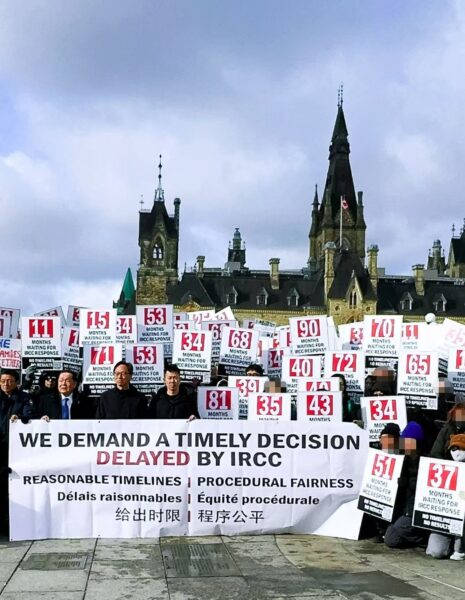
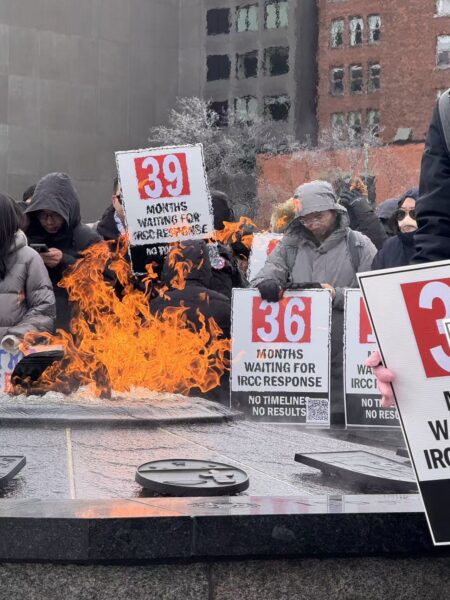
On March 13, 2026, a group of Chinese immigrant applicants gathered on Parliament Hill in Ottawa holding placards that displayed how long they had already been waiting in security screening: “28 months,” “34 months,” “41 months.” They were protesting prolonged delays in the security screening stage of permanent residence applications.
According to the event’s press release, more than 200 applicants and supporters from across Canada attended the peaceful gathering. Many participants have lived and worked legally in Canada for years, yet their permanent residence applications remain stalled at the final stage of security screening.
The protesters’ demands were straightforward: establish clear timelines for security screening, improve transparency in the process, and introduce mechanisms for accountability.
In a country that prides itself on the rule of law and procedural fairness, such requests are hardly unreasonable. Yet the protest raises a deeper question that goes beyond the frustration of individual applicants: what happens to public trust when administrative processes lack transparency and clear temporal boundaries?
A Protest About Waiting
The demonstration was organized by an advocacy network known as Chinese PR Delay. The group argues that many permanent residence applications, once referred to security screening, effectively enter an administrative process with no clear timeline and little communication.
Applicants’ experiences tend to follow a strikingly similar pattern: documents are submitted, medical exams are passed, the application enters security screening—and then the waiting begins.
In many cases, that waiting stretches into two or three years, or even longer.
Organizers cite publicly available information indicating that more than 23,000 permanent residence applicants are currently undergoing security screening. They emphasize that while they respect Canada’s need for security checks, applicants’ lives should not remain indefinitely suspended without communication or reasonable timelines.
The issue has increasingly attracted media attention. Nicholas Keung, the immigration reporter for the Toronto Star, has written extensively about immigration processing delays and the growing number of applicants seeking mandamus orders from the Federal Court to compel government action.
When similar experiences repeatedly emerge within the same community, the issue moves beyond isolated administrative delays and becomes a broader public concern.
More importantly, the consequences are not abstract. The protest organizers cited several examples.
One case involves a physician trained in China who has passed the Medical Council of Canada qualifying examinations and received certification from the Collège des médecins du Québec. Despite these qualifications, his permanent residence application has been stalled in security screening for more than 13 months, preventing him from entering the residency matching process at a time when Canada faces a severe physician shortage.
Another case involves a family who applied for permanent residence through a provincial nominee program in 2021, but whose application remains in security screening. Their adult daughter now worries that getting married could jeopardize her ability to obtain permanent residence alongside her parents.
A third case involves a woman who first came to Canada as an international student in 2008 and later became a permanent resident. In 2021, she sponsored her parents for family reunification, but their application has also been stalled in security screening, leaving the family separated for years.
In these cases, waiting is no longer merely an administrative step—it becomes a profound disruption to people’s lives.
An Expanding Government, A Sluggish System
At the same time, the size of Canada’s federal public service has grown significantly.
According to statistics from the Treasury Board Secretariat, the number of federal public servants increased from approximately 257,000 in 2015 to 367,000 in 2024, an increase of more than 100,000 employees—nearly 40 percent growth over a decade.
Meanwhile, the cost of maintaining the federal public service has also risen. Analyses by the Parliamentary Budget Officer indicate that personnel costs for the federal public service now exceed $70 billion annually.
In 2023, the government reached a new collective agreement with the Public Service Alliance of Canada (PSAC), providing a cumulative wage increase of about 11.5 percent over four years.
The expansion of the public service and rising wages do not, by themselves, constitute a governance problem. Any modern state requires a large administrative apparatus. But as government grows and budgets expand, the public inevitably asks a simple question:
Why has the efficiency of key public services not improved at the same pace?
Immigration processing has become one of the most visible examples of this tension. Security screening, in particular, has long been considered one of the most opaque and unpredictable stages in the immigration process.
For applicants, extended waiting periods are not abstract bureaucratic procedures—they are life-altering realities.
Policy Ambition and Administrative Capacity
At the same time, Canada continues to expand its immigration and humanitarian commitments on the global stage.
In March 2026, Prime Minister Mark Carney announced a new Canada–India Talent and Innovation Partnership during a visit to India, aimed at attracting more high-tech professionals to Canada.
Canada also maintains substantial humanitarian commitments. According to Global Affairs Canada, the country provided more than $11 billion in international assistance in 2023–2024, including approximately $800 million in emergency humanitarian aid.
These policies reflect Canada’s long-standing values of openness, inclusiveness, and humanitarian responsibility. Yet in this context, the protest on Parliament Hill appears particularly striking.
How can a country that provides extensive humanitarian support around the world allow its own administrative processes to create prolonged human hardship at home?
If administrative systems cannot process existing applications within reasonable timeframes, expanding immigration initiatives may only exacerbate existing pressures.
Concerns Within the Chinese Canadian Community
The protest has resonated strongly within the Chinese Canadian community, partly due to the broader political climate of recent years.
Discussions about foreign interference and national security have increasingly entered Canada’s public discourse. In this environment, some worry that security screening procedures may unintentionally amplify suspicion toward applicants from certain countries.
Senator Yuen Pau Woo and former senator Victor Oh attended the protest. Senator Woo emphasized that while security screening is necessary to protect Canada, it must also respect procedural fairness and reasonable timelines. Applicants, he argued, should not face excessive national security scrutiny simply because of vague or exaggerated fears about immigrants from China. Even if such concerns are not entirely grounded in reality, a lack of transparency within the system itself can easily erode trust.
In his reporting for the Toronto Star, Nicholas Keung cited immigration lawyers who observed that among the cases they handle involving prolonged security screening delays, applicants from mainland China appear in disproportionately high numbers. Some lawyers estimate that they may account for as much as 40 percent of such cases.
Yet according to Canada’s Annual Report to Parliament on Immigration, applicants from mainland China represent roughly 5 percent of all permanent residents admitted to Canada.
If a group that represents a relatively small proportion of overall immigration appears disproportionately in cases of prolonged security screening delays, the system itself requires greater transparency and explanation.
Waiting Should Not Become a System
Ultimately, the protest on March 13 raises a simple but profound question: In a country that prides itself on the rule of law and procedural fairness, can administrative authority allow an ordinary person to wait for years without clear timelines or explanations?
If the answer is yes, public trust in government institutions will inevitably erode.
If the answer is no, policymakers must confront the issue directly.
Is the problem administrative capacity? Is it flawed process design? Or do aspects of security screening require reassessment?
The protest on Parliament Hill did not dominate national headlines. Yet the waiting experienced by many applicants continues.
Their experiences remind us that the true value of a system lies not in its policy declarations, but in whether an ordinary individual can receive a clear and fair answer within a reasonable time. In a country that takes pride in the rule of law and humanitarian values, waiting should not become a system in itself.
References
Treasury Board of Canada – Federal Public Service population
https://www.canada.ca/en/treasury-board-secretariat/services/innovation/human-resources-statistics/population-federal-public-service.html
Toronto Star – Nicholas Keung immigration reporting
https://www.thestar.com/authors.keung_nicholas.html
Government of Canada – Annual Report to Parliament on Immigration
https://www.canada.ca/en/immigration-refugees-citizenship/corporate/publications-manuals/annual-report-parliament-immigration.html
Global Affairs Canada – International Assistance Report
https://www.international.gc.ca/transparency-transparence/international-assistance-report
PR Justice Now
https://chinese-pr-delay.ca/#demands