
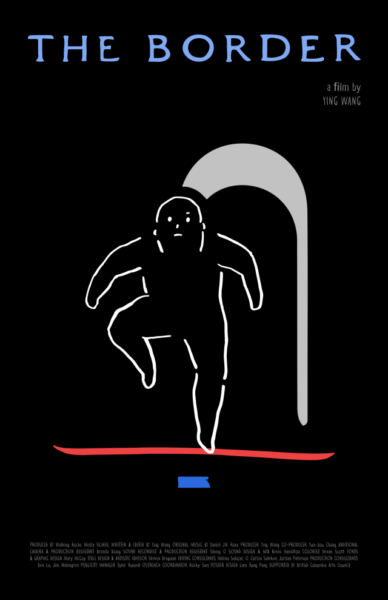
Border, Freedom, and the Changing Canada–U.S. Relationship in Ying Wang’s Documentary THE BORDER
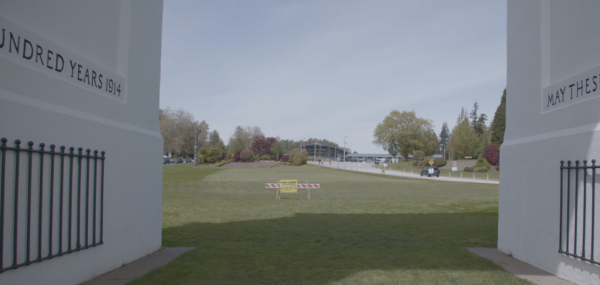
South of Vancouver, Highway 99 runs toward the United States and ends at a white archway. One side of the arch stands in Canada and the other in the United States. Inscribed within it is an almost idealistic wish: “May these gates never be closed.” Surrounding the monument is what is commonly known as Peace Arch Park.
“Peace Arch Park” is actually made up of two adjoining parks under separate national jurisdictions: Peace Arch Provincial Park, administered by the Province of British Columbia on the Canadian side, and Peace Arch Historical State Park, administered by the State of Washington on the American side. The Peace Arch monument itself straddles the international boundary, causing the two parks to appear visually as a single space. Legally, however, the border remains in force. Anyone entering the American side has entered U.S. territory, and anyone returning to Canada remains subject to Canadian entry requirements.
For more than a century, Peace Arch represented a particular kind of Canada–U.S. relationship: two countries with a clearly defined border, yet an exceptionally broad degree of freedom rooted in mutual trust. The border served the functions of sovereignty, customs control, and security while preserving an open space for families, trade, travel, and everyday life.
Ying Wang’s documentary THE BORDER records the period in which that arrangement began to change.
Before the Border, There Was No Boundary Here
The history of Peace Arch cannot be told solely through the 1814 Treaty of Ghent or the national histories of Canada and the United States.
The park stands on the traditional territory of the Semiahmoo First Nation, whose lands extend across areas now known as Washington State, the Salish Sea, and British Columbia’s Lower Mainland. The Semiahmoo people maintain kinship and cultural ties with Indigenous nations south of the border, including the Lummi and Nooksack. The international boundary divided their traditional lands, but it did not erase those cross-border relationships.
For modern states, the 49th parallel is a line of sovereignty. For the Indigenous peoples who had lived in the region for thousands of years, it was a line imposed much later. Bays, rivers, fishing grounds, seasonal camps, and kinship networks were not originally organized according to the Canada–U.S. border.
The “peace between two countries” celebrated by the Peace Arch therefore reflects a historical limitation. It tells the story of peace established after conflict between Britain and the United States, but says little about the Indigenous peoples who lived on the land before the boundary was drawn or about the way the border divided their traditional territories.
In 2018, a replica Haida totem pole was raised in Peace Arch Provincial Park on the Canadian side. The British Columbia government acknowledged that the site is located on the traditional territory of the Semiahmoo First Nation, bringing Indigenous land, colonial borders, and historical memory more explicitly into the story of Peace Arch.
From a Memorial to War to a Symbol of Peace
When the United States went to war with Britain in 1812, what is now Canada remained part of British North America. The Treaty of Ghent ended the war in 1814, and the Rush–Bagot Agreement of 1817 later restricted British and American naval forces on the Great Lakes. Much of the Canada–U.S. boundary in the region where Peace Arch now stands was established along the 49th parallel under the Oregon Treaty of 1846.
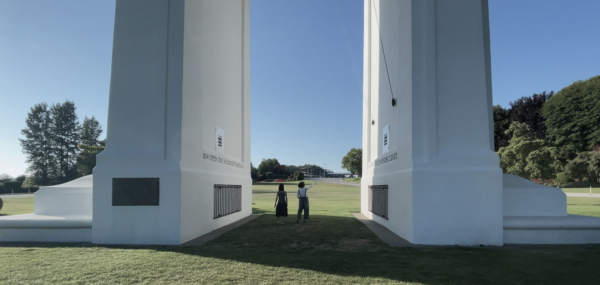
About a century after the boundary was established, American lawyer and philanthropist Samuel Hill promoted the construction of the Peace Arch to commemorate the peace that followed the war. The monument was dedicated on September 6, 1921. Standing approximately 67 feet high, it was constructed with a steel framework and concrete exterior.
In 1931, with support from schoolchildren in Washington State and British Columbia who jointly donated approximately US$1,200, the land surrounding the monument was expanded and improved. The American side became a Washington state park that same year. In 1939, the Canadian side was formally dedicated as Peace Arch Provincial Park.
The inscriptions on the two sides of the arch express its political ideals. The side facing the United States bears the words “Children of a common mother,” referring to the two countries’ shared British heritage. The side facing Canada reads, “Brethren dwelling together in unity,” expressing the hope that neighbouring countries might live together in harmony. Inside the arch appears its best-known inscription: “May these gates never be closed.”
These words reflect the assumptions of the early twentieth century. The phrase “common mother” primarily refers to Britain and does not fully encompass French Canadians, Indigenous peoples, immigrant communities, or the diverse societies that both countries later became. Its central aspiration, however, is clear: borders may exist without being militarized, and two independent countries may still sustain frequent contact among individuals, families, and communities.
When a Symbol Became Part of Everyday Life
In March 2020, Canada and the United States reached a reciprocal arrangement restricting non-essential land travel from each other’s territory. British Columbia subsequently closed the Canadian side of Peace Arch Park in June, while the American park remained open.
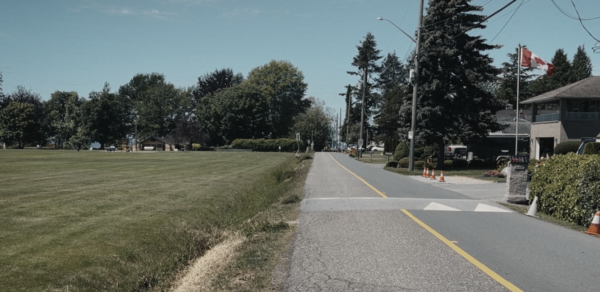
Because Zero Avenue runs directly along the northern edge of the American state park, Canadian residents were still able to cross the unfenced boundary into the U.S. park, remain within the park, and return by the same route. This allowed them to meet relatives arriving from the American side.
For ordinary people, border restrictions meant separated spouses, parents unable to visit their children, and grandparents unable to embrace their grandchildren. Weddings, funerals, family reunions, and caregiving were all affected.
Peace Arch Park consequently became one of the few places where cross-border families could still meet. National policy was translated there into specific experiences of waiting, reunion, and separation. These encounters form part of the central visual record of THE BORDER.
Wang herself was living through the separation created by the pandemic: she lived in British Columbia, while her sister lived in Washington State. Filming began in 2020. In her images, the border is not merely a line on a map. It appears as tents in the rain, brief reunions, and family members who meet but cannot leave together. The documentary records the real lives behind policy terms such as “necessary,” “temporary,” and “security.”
When the Border Reopened, It Did Not Return to What It Had Been
In November 2021, the United States again permitted eligible Canadian travelers to make non-essential land crossings. Peace Arch Provincial Park on the Canadian side reopened in October 2022. Wang continued filming until 2024, giving the documentary a significance beyond its record of life during the pandemic.
In May 2024, U.S. authorities ended the practice of allowing Canadian residents to enter the American side of Peace Arch Park directly from Zero Avenue. Canadian residents could still visit Peace Arch Provincial Park on the Canadian side, but those wishing to visit the American park were required to enter through an official port of entry and undergo inspection by U.S. Customs and Border Protection.
Several months later, Donald Trump was elected president again, and “America First” returned to the center of U.S. policy. Although the Peace Arch restriction was not initiated by the Trump administration, it remained in place amid the new political climate and came to symbolize a shift in Canada–U.S. relations.
A border does not always need a physical wall in order to become more restrictive. A change in rules can cause such a wall to appear almost overnight.
A similar development occurred in 2025, when the United States restricted the previous means by which Canadian residents entered the Haskell Free Library and Opera House, a building that straddles the Quebec–Vermont boundary and has long served as another symbol of cross-border cooperation.
The Fragility of Freedom
“May these gates never be closed” is not a legally binding promise. It cannot override immigration law, customs law, or government border policy.
Does peace mean only that two countries are not at war, or does it also include the ability of ordinary people to maintain family and community ties safely? Is a border necessarily open simply because no soldiers are stationed along it? As national-security rules expand, how much space remains for local practices and specific human needs? These are among the questions contained within the documentary.
From the traditional territory of the Semiahmoo people, the treaties that followed the War of 1812, and the construction of the Peace Arch in 1921, to the cross-border reunions of the pandemic and the access restrictions imposed in 2024, the small field that fills with daisies each spring bears the imprint of overlapping histories.
Ying Wang’s THE BORDER captures a rare historical moment. It records the quiet rupture of a relationship built over the course of a century. It is a film about the fragility of freedom.
The Peace Arch still stands between Canada and the United States, and the words inscribed upon it have not changed. What has changed are the rules governing passage and the way people understand those words.
“May these gates never be closed” is no longer merely a description of an established relationship. It has once again become a hope for the future.