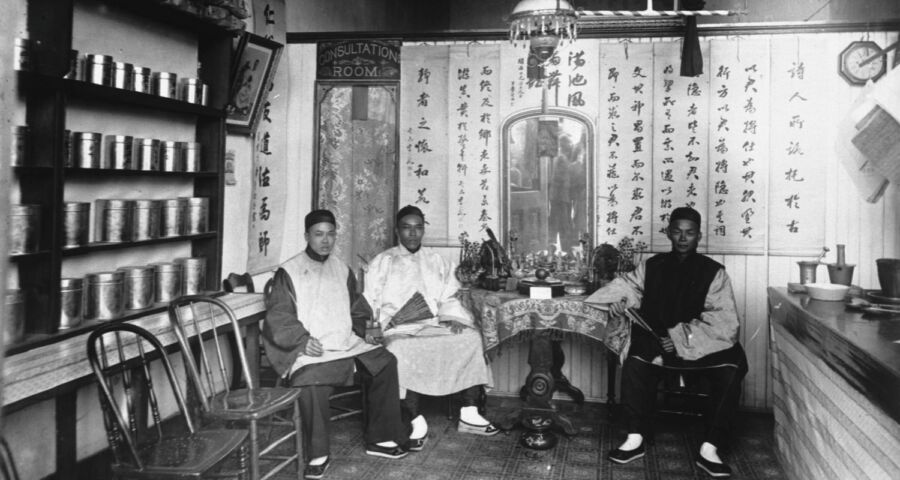
Every year I begin the semester by asking my college students, “What do you know about Asian American history? What have you been taught?” The most frequent answer I get is (a sheepish): “nothing.” When pressed, students will usually recall that “the Chinese built the railroad” and “Japanese internment was a mistake.” Most of the time they learned these bare facts based on a few paragraphs in their high school textbook.
There is nothing natural about this knowledge gap. Asians are the fastest growing racial group in the United States today, and their history in this country stretches back centuries. Starting in the 1850s, Chinese immigrants drained the swamp lands of California to make way for agriculture, blasted tunnels through the Sierra Mountains for the transcontinental railroad, and felled trees to construct the towns and cities of the U.S. West. At the same time, their presence—and their resistance—transformed the legal structures of the nation.
If you want to know more about the history of Chinese Americans, Asian Americans, and the discriminatory laws their presence inspired, I recommend the following books:
For a primer on Asian American history, I’d start with Erika Lee’s
The Making of Asian America. It is a difficult task to trace each strand of America’s diverse Asian community and braid them together into a single volume. But Lee has done it. She recounts generations of immigrants—from Filipino sailors to Chinese gold miners, Japanese farmers, and Vietnamese refugees—and the prejudice they encountered in the United States. For the younger reader, Lee has published
Made in Asian America, which offers an introduction appropriate for the middle grades. Young readers will find stories of survival and resistance, as well as hard truths about America’s history of discrimination.
Chinese workers played an important role in America’s westward expansion in the nineteenth century. Most famously, they helped to build the transcontinental railroad, which connected California to the eastern states. Gordon Chang captures the scale of this awesome feat, as well as the sacrifices made in attaining it, in
Ghosts Of Gold Mountain. He carefully mines the scant historical record to find the stories of Chinese railroad workers who laid track through the Sierra Nevada Mountains and across the Utah desert.
Starting in 1882, a series of exclusion laws barred most Chinese immigrants from coming to United States. Three decades later, in 1910, the U.S. government opened a new immigration station on an island in the San Francsico Bay to help process and detain Chinese immigrants. Stuck in detention for days, weeks, or months, Chinese immigrants began carving poems into the barracks walls.
In
Island, Him Mark Lai, Genny Lim, and Judy Yung transcribed and translated the poetic graffiti of Chinese detainees. Their words of grief, protest, and survival still hold power today.
Chinese exclusion laws laid the foundation for modern immigration control in the United States. In this important book,
The Migrant’s Jail, Brianna Nofil reveals that Chinese exclusion also provided the blueprint for modern immigration detention. At the turn of the twentieth century, federal immigration officials began to outsource the detention of Chinese immigrants to local jails. Thus began a tradition of cooperation between immigration bureaucracy and the criminal justice system, one that gave rise to mass immigrant detention in the United States today.
The title of Kelly Lytle Hernández’s new book is also it’s thesis: U.S. immigration control is, and has always been, “racist by design.” Scholars have made this point before, but none in such a comprehensive and accessible format.
Racist by Design begins with the Haitian Revolution in 1791, Americans’ mounting fear of Black abolitionists from the Caribbean, and the attempts to bar them via state and federal law. Hernández connects these anti-Black immigration policies to the history of Chinese Exclusion, the Mexican border, the U.S. visa system, and much more. The book makes clear how Chinese American history connects to the wider history of U.S. immigration control.
Beth Lew-Williams is Professor of History and Director of the Program in Asian American Studies at Princeton University. She is the author of The Chinese Must Go: Violence, Exclusion, and the Making of the Alien in America.