
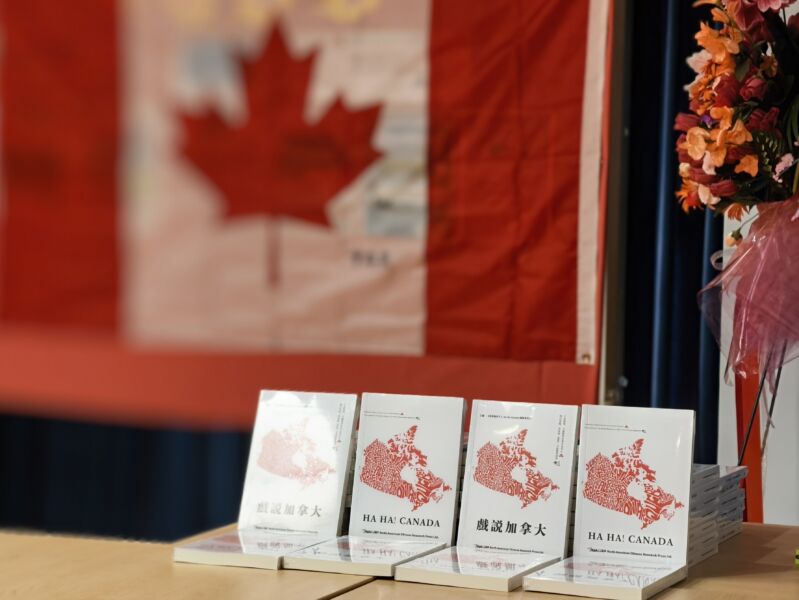
(Photo by Kenny Zhang)
From Chinatown’s history and Chinese-language education to public art and civic engagement, a new bilingual book brings generations of Chinese Canadians together.
By Yi Gong | Vancouver, November 14, 2026
The Chinese Cultural Centre of Greater Vancouver hosted the Vancouver launch of Ha Ha! Canada (《戏说加拿大》), a new bilingual collection of personal stories, on November 14, 2026. The gathering brought together writers, artists, educators, researchers, community volunteers, public officials and readers for an afternoon of conversation about Chinese Canadian history, cultural identity, community service, anti-racism and civic participation.
More than a traditional book launch, the event provided an opportunity for people from different generations and backgrounds to reflect on their experiences in Canada and consider how individual stories contribute to a broader understanding of Canadian society.
The Ha Ha! Canada project grew out of a global Chinese diaspora writing and discussion initiative launched by Mothersbridge of Love, a UK-based charitable organization. The Chinese Cultural Centre of Greater Vancouver subsequently took the lead in bringing the Canadian collection to publication.
The initiative encourages people of Chinese heritage living around the world to remain connected to their cultural roots while becoming more engaged in the communities and countries they call home.
The Vancouver event was moderated by Dr. Ally Wang, Vice-Chair of the Chinese Cultural Centre and coordinator of the Ha Ha! Canada project.
Speakers included Centre Chairman Fred Kwok, Executive Director Tima Tao, British Columbia MLA David Xie, artist Shuren Cheng, and Chinese Canadian immigration history researcher Jing Liu, along with contributing authors and community members.
Fifty-Seven Stories from Across Canada
Published by North American Chinese Research Press, Ha Ha! Canada is available in separate Chinese and English editions, each with its own ISBN.
The collection features 57 stories selected from 155 submissions received from across Canada. The contributors represent different generations, professions, communities and immigration experiences.
Senator Yuen Pau Woo contributed a foreword of recommendation, while Dr. Laifang Leung, Tung Chan and Fred,Kwok were among those who provided endorsements for the book.
The stories explore immigration, cultural differences, family life, personal growth, social observations and the search for belonging. Some describe the uncertainty of arriving in a new country, while others reflect on the gradual process of understanding Canadian society and finding one’s place within it.
Despite its playful title, Ha Ha! Canada is not simply a collection of humorous anecdotes. Through accessible, personal storytelling, it invites readers to discover the complexities, challenges and everyday experiences that shape life in a multicultural country.
Chinatown and the Importance of Community Institutions
Fred Kwok, Chairman of the Chinese Cultural Centre of Greater Vancouver, reflected on the history of Vancouver’s Chinatown and the role of the Cultural Centre, whose establishment dates back to 1973.
For generations of Chinese immigrants, Chinatown was more than a place to live and work. It was where newcomers built mutual-support networks, preserved cultural traditions, established schools and community organizations, and worked toward greater recognition in Canadian society.
As demographics, lifestyles and settlement patterns have changed, traditional Chinatowns and their cultural institutions have faced new challenges.
Kwok emphasized the continuing importance of institutions that preserve historical memory, maintain cultural connections and bring together people across generations. The Cultural Centre’s role, he suggested, extends beyond providing a physical space for activities. It also serves as a link between the experiences of earlier immigrants and the aspirations of today’s Chinese Canadian communities.
Chinese-Language Education and the Spirit of Volunteerism
Tima Tao, Executive Director of the Chinese Cultural Centre, spoke about the development of Chinese-language education and her many years of volunteer involvement in the community.
Chinese schools have played an important role in helping younger generations learn their heritage language while developing an understanding of family traditions, immigration history and cultural identity.
For young Chinese Canadians growing up in a multicultural environment, language education can provide a connection to their roots while helping them navigate life in Canadian society.
Tao also highlighted the sustained commitment of educators, parents and volunteers. Many community members contribute significant time and energy to cultural, educational and charitable activities alongside their professional and family responsibilities.
Such contributions, often made quietly over many years, have helped build and sustain Chinese Canadian community institutions.
Protecting Chinatown Through Public Art
Artist Shuren Cheng offered another perspective on immigration, cultural identity and community responsibility.
Over the years, Cheng has created numerous sculptures, murals and other public artworks in Vancouver’s Chinatown. His work has contributed to the neighbourhood’s visual identity while documenting aspects of Chinese Canadian history and community life.
For Cheng, Chinatown is not simply a historic district. It is a cultural home shaped by generations of immigrants and their descendants.
He also discussed his ongoing efforts to maintain and protect public artworks, particularly when they have been damaged or threatened by vandalism and racism.
Repairing murals and preserving sculptures, he explained, are practical ways of defending community dignity and protecting shared cultural heritage.
His experience demonstrated that community participation can take many forms. Preserving history is not only about recording the past; it also requires people willing to protect cultural spaces in the present.
Personal Stories as Part of Canadian History
Jing Liu, who heads the Chinese section of the University of British Columbia’s Asian Library and researches Chinese Canadian immigration history, spoke about the relationship between personal experience and historical understanding.
Liu, who also contributed the book’s afterword, drew on his own immigration experience to reflect on the challenges of adapting to a new country.
The process of immigration often involves unfamiliar languages, different cultural expectations, rebuilding professional and family lives, and gradually developing a sense of belonging.
While each experience is personal, these individual memories collectively form an important part of a community’s history.
Liu’s reflections highlighted the value of everyday accounts as historical records. Immigration history is found not only in government archives and major public events, but also in family memories, personal narratives and ordinary experiences.
In this sense, the stories collected in Ha Ha! Canada offer valuable perspectives on the lives of Chinese Canadians and the development of Canada’s multicultural society.
From Community Involvement to Public Service
British Columbia MLA David Xie shared his personal journey from growing up in the community to becoming involved in public affairs and eventually entering elected office.
His remarks brought the discussion to a broader question: What does it mean to participate fully in Canadian society?
For immigrants and their descendants, integration involves more than studying, working and building a life in Canada. It also means understanding public institutions, paying attention to community issues and taking part in civic life.
Volunteering, joining community organizations, participating in public discussions, voting and serving in elected office are all ways people can contribute.
Xie’s experience reflected a generational shift within Chinese Canadian communities—from the early struggles of immigrants establishing themselves in a new country to the growing participation of Chinese Canadians in public life and decision-making.
Many Voices, a Shared Canadian Experience
Several contributing authors, including Banzhang, Lisa Chen, Weizhi Lin, Feng Lin, Jingsheng Ren, Bin Li, Cynthia Shi and Yanqiang Jia, joined the discussion and shared their reflections on the book and their experiences in Canada.
Community participants, including representatives from Chuan Deng Temple and local community member Jackie Lee, also contributed to the conversation.
Project supporter Brian Zhang spoke briefly about his own experience of community involvement and why he chose to support the initiative.
The wide range of contributions reflected the central idea behind Ha Ha! Canada: people may live in the same country while experiencing it in very different ways.
Some remember the difficulties of their early years as immigrants. Others focus on the challenges of language and cultural adaptation. Still others find a sense of purpose through education, volunteering, artistic expression or public service.
Together, these experiences form part of the larger story of Canada.
Cultural Heritage and Civic Participation Can Go Hand in Hand
A recurring theme throughout the afternoon was that maintaining one’s cultural heritage and participating fully in Canadian society are not competing goals.
Preserving language, traditions and historical memory can go hand in hand with learning about Canadian institutions, embracing civic responsibilities and contributing to the wider community.
This is also the broader purpose of the Ha Ha! Canada initiative.
Rather than focusing solely on book promotion, the organizers hope to use personal stories as a starting point for ongoing community conversations about Canadian society, belonging and public participation.
The project seeks to encourage Chinese Canadians to take a greater interest in the communities where they live, become more involved in local affairs and contribute to Canada’s future while maintaining their cultural identities.
A Canadian Flag to Travel Across the Country
To mark the beginning of the national book tour, the Chinese Cultural Centre of Greater Vancouver prepared a Canadian flag that will accompany Ha Ha! Canada as it travels from the West Coast to the East Coast.
Beginning in Vancouver, the flag will be presented at community events across the country, with participants invited to add their signatures.
The journey is expected to conclude in St. John’s, Newfoundland and Labrador.
Following the tour, the flag will be preserved by the Chinese Cultural Centre as a lasting record of the communities and individuals who participated in the project.
The flag offers a tangible symbol of the initiative’s message: people from different provinces, backgrounds and generations can share a common commitment to the country they call home.
A National Conversation Continues
Following the Vancouver launch, Ha Ha! Canada is scheduled to continue its community events in several Canadian cities, including Coquitlam on November 22, Montreal on November 23, Charlottetown on December 6, Fredericton on December 8, Calgary on January 14, 2027, and Edmonton on January 16.
The organizers hope these gatherings will develop into a broader series of community discussions, connecting personal experiences with questions about cultural identity, local involvement and civic responsibility.
One book. Ten provinces. Dozens of lives.
Ha Ha! Canada is more than a collection of Chinese Canadian stories. It is an invitation to reflect on what it means to belong, participate and help shape the communities we share.
For information about the book and upcoming events, contact hahacanadabook@gmail.com.