
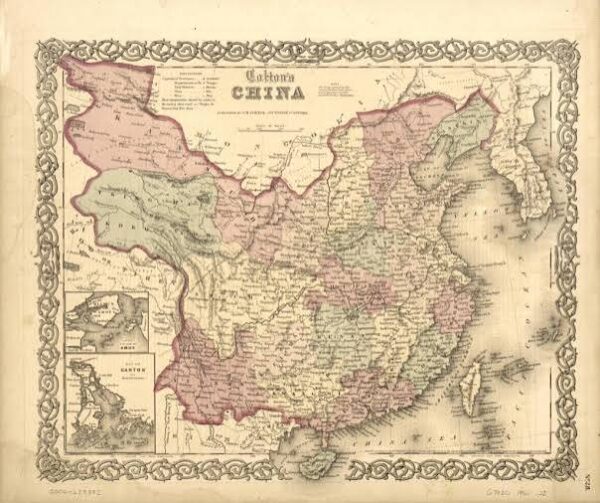
Map of China. The pink in the bottom right center is Canton, and an enlarged portion is the lower left square. Colton’s China, 1861, J.H. Colton: New York (Library of Congress/ Geography and Map Division)
As part of my Junior Fellow project, “Exploring American Business History in the First Industrial Revolution,” one of my tasks this summer was to write a “This Month in Business History” entry about the 1867 Sierra Strike by Chinese railroad laborers against the Central Pacific Railroad Company. This sparked my interest in the development of Chinatowns and how Chinese immigrants found support and community in the United States. As a Chinese American, these thoughts have been on my mind prior, but now I had the opportunity to flesh them out. What I found was the Chinese Consolidated Benevolent Association (CCBA). This association would eventually have branches throughout the United States, but the first and most influential, was the San Francisco branch. This branch was known as “The Chinese Six Companies,” or just “The Six Companies.” The association’s history extends into the twenty-first century, but since my Junior Fellowship project focuses on the First Industrial Revolution, this blog will discuss the group’s earlier history.
Immigration from China to the United States began with the Gold Rush, and continued to grow with the construction of the railroads and mining. At the time, it was mostly men, who were often leaving families behind in China. When a Chinese person immigrated to San Francisco, they were automatically under the protection of what was called their district association. Each of these district associations was comprised of people originally between one and five (depending on population size) districts of Guangdong, China. Guangdong, and specifically the Pearl River Delta region, historically referred to as Canton, was where most of the Chinese immigrants originated from. The area was experiencing much socio-political and economic turmoil due to the Opium Wars.
District associations began forming around 1851 and would assist only those who originated from their specified districts. For instance, the Ning Yeung district association was for those from the Toyshan district. This district association held priority over other fraternal organizations in Chinatown society.
By 1870, there were around 50,000 Chinese people living in California alone. Eventually, rising amounts of in race-based crime against Chinese immigrants, and a general disdain for the Chinese, made worse by an economic downturn, led to an increased need for protections and assistance for Chinese immigrants. This gap was filled by the CCBA.
The Chinese Consolidated Benevolent Association, or CCBA, was formed from representatives of the different district associations of San Francisco and assumed the responsibility of advocating for the interests and welfare of all the Chinese immigrants, regardless of their originating district. The Six Companies, in particular, was originally formed from five of these district associations: Kong Chow, Ning Yeung, Sam Yup, Yeong Wo, and Yan Wo. In 1882, the sixth district association, Hop Wo, joined the San Francisco CCBA, leading to the moniker, The Chinese Six Companies, a nickname coined and used by Americans. In Chinese, the CCBA overall is known as Chung Wah Kung Saw or Chung Wah Wui Kwoon – Meeting Hall of the Chinese people. Over the course of its history, The Six Companies has had from six to eight member-district associations (with the addition of Shew Hing and the short-lived Yin-Hoi association in the 1890s), but the nickname remained the same.
The CCBA had representatives from each member district association. The number of representatives was based on the percentage of the Chinese immigrant population of the region that each district represented. For example, Ning Yeung had the largest percentage of the population and therefore had the most representatives. Leaders of the CCBA were traditionally chosen from the scholarly class. Since most Chinese immigrants were not scholars, in the beginning, the CCBA would recruit scholars from China. However, as the merchant class rose in power, merchants became the de facto class for heads of the district associations and therefore the CCBA.
When a Chinese person arrived in San Francisco, they were welcomed upon arrival at the wharf by an agent and guided to the CCBA building, pictured above, to be registered. The district association was the primary organizational structure of the association; people were duty bound to support their districts. Originating from one of the regions represented by a district meant that that district association’s resources, such as housing, legal aid and job assistance were automatically available to an individual. Membership dues were only collected when the CCBA wanted to conduct a census of members.
The CCBA also funded many immigrants’ voyages from China using a credit ticket system. This helped increase the Chinese labor force. Chinese people wanted to immigrate but, lacking in resources, would get a loan to fund their tickets with the understanding that they would pay the loan back with money they would earn from laboring. This led anti-Chinese organizations to accuse the CCBA of importing Chinese people, likening it to slavery or indentured serfdom, since it was well-known that paying the ticket back would be difficult based on the salary of a laborer. The CCBA also worked with different industries, such as mining and railroads, to supply workers and when laborers were between jobs they could stay in the association building for the time being.
The CCBA established branches in many of the cities and regions that Chinese immigrants settled. Each region and CCBA had different district associations depending on the specific Chinese immigrant demographic present. All branches operated autonomously in their own regions (e.g. British Columbia, New York, Sacramento) but the San Francisco branch, The Six Companies, often spoke on behalf of Chinese people across the United States.
While there are debates over the actual quality of CCBA services, given that primary source material was often polished to combat negative assumptions at the time, it is undeniable that the CCBA was the recognized voice of Chinese immigrants. They often had representatives in government meetings and wrote many petitions voicing their grievances with anti-Chinese actions. They also kept attorneys on retainer and employed security for Chinatowns.
Though their influence peaked in the late 19th century, the Chinese Consolidated Benevolent Association, having provided assistance with housing, legal services, jobs and more to Chinese immigrants since 1854, the association continues today, but has less engagement with American-born generations. Founded in traditional Chinese collectivist ideals, the CCBA is integral to the story of Chinese immigration, affecting not only the business history of the area but shaping the socio-cultural history as well.
Research into The Six Companies provides a view into the life and experiences of a Chinese immigrant from the standpoint of how they organized themselves within society, especially valuable since primary records of Chinese immigrants, like those who worked on the railroad, are rare.
Read more about Chinese Immigrants and the CCBA:
- The Cultural Clash: Chinese Traditional Native-Place Sentiment and the Anti-Chinese Movement, by Yucheng Qin, 2016.
- “Historical Development of the Chinese Consolidated Benevolent Association/Huiguan System,” by Him Mark Lai, 1987. Online PDF [20 pages/2.4 MB]
- The Chinese Six Companies, by William Hoy, 1942.
- To His Excellency U.S. Grant, President of the United States: A memorial from Representative Chinamen in America, by the Chinese Consolidated Benevolence Association, 1876.
- Chinese American Voices: From the Gold Rush to the Present, by Judy Yung, Gordon H. Chang, and Him Mark Lai, eds., 2006.
- Memorial of the Six Chinese Companies: An Address to the Senate and House of Representatives of the United States, by the Chinese Consolidated Benevolence Association, 1877.
- “The Chinese Six Companies,” Golden Gate National Recreation Area, National Park Service, 2024.
- Official Map of “Chinatown,” San Francisco, by W.B. Farwell, John E. Kunkler, E.B. Pond, 1885.
- The Chinese in California, UC Berkley Libraries and California Historical Society Collection, 1850-1925.
If you are interested in more Business and Science topics, then subscribe to Inside Adams — it’s free!