
The New York Historical’s Student Historian internship focuses on the four core pillars of Frederick Douglass’s Our Composite Nation speech: absolute equality, composite nationality, religious liberty, and hope. In a post-Civil War America, commonly referred to as the Reconstruction Era, Douglass was a prolific abolitionist and orator. In his speech, he called for absolute equality regardless of religion, race, or ethnicity. He believed that diversity and inclusion would fuel a stronger, more refined nation. As Student Historian interns, we are using the themes of the Our Composite Nation speech, along with various artifacts from The New York Historical’s archives, to conduct hands-on, in-depth research. We collaborate with our peers to produce creative digital humanities projects, showcasing all the research and scholarship accomplished across the 29-week internship period. The options for the digital humanities are endless and range from digital exhibitions to podcasts. At the end of the internship, after all of the research, analysis, and writing done, we left with a profound understanding of American history and the Reconstruction Era. We developed nuanced perspectives concerning Our Composite Nation and how it can be applied to each primary source, and its broader implications and themes.
A decade after the passage of the Chinese Exclusion Act, the federal government extended exclusion another ten years with the Geary Act of 1892. The act required all Chinese people living in the United States to register for documentation and carry papers of identification at all times. In response to the bill, Wong Chin Foo and 150 other English-speaking Chinese merchants and businessmen, also known as the Chinese Equal Rights League, assembled a mass meeting at the Cooper Union in New York City on September 22, 1892. Over a thousand prominent Americans attended this first meeting, and by the end, the printed pamphlet, the Appeal of the Chinese Equal Rights League, was published, recounting the proceedings of the meeting. The Chinese Equal Rights League continued to host many other gatherings across the country in Boston, Chicago, and Philadelphia, advocating against the passage of the Geary Act. By 1898, the league had amassed a membership of 8,000 Chinese men nationwide.
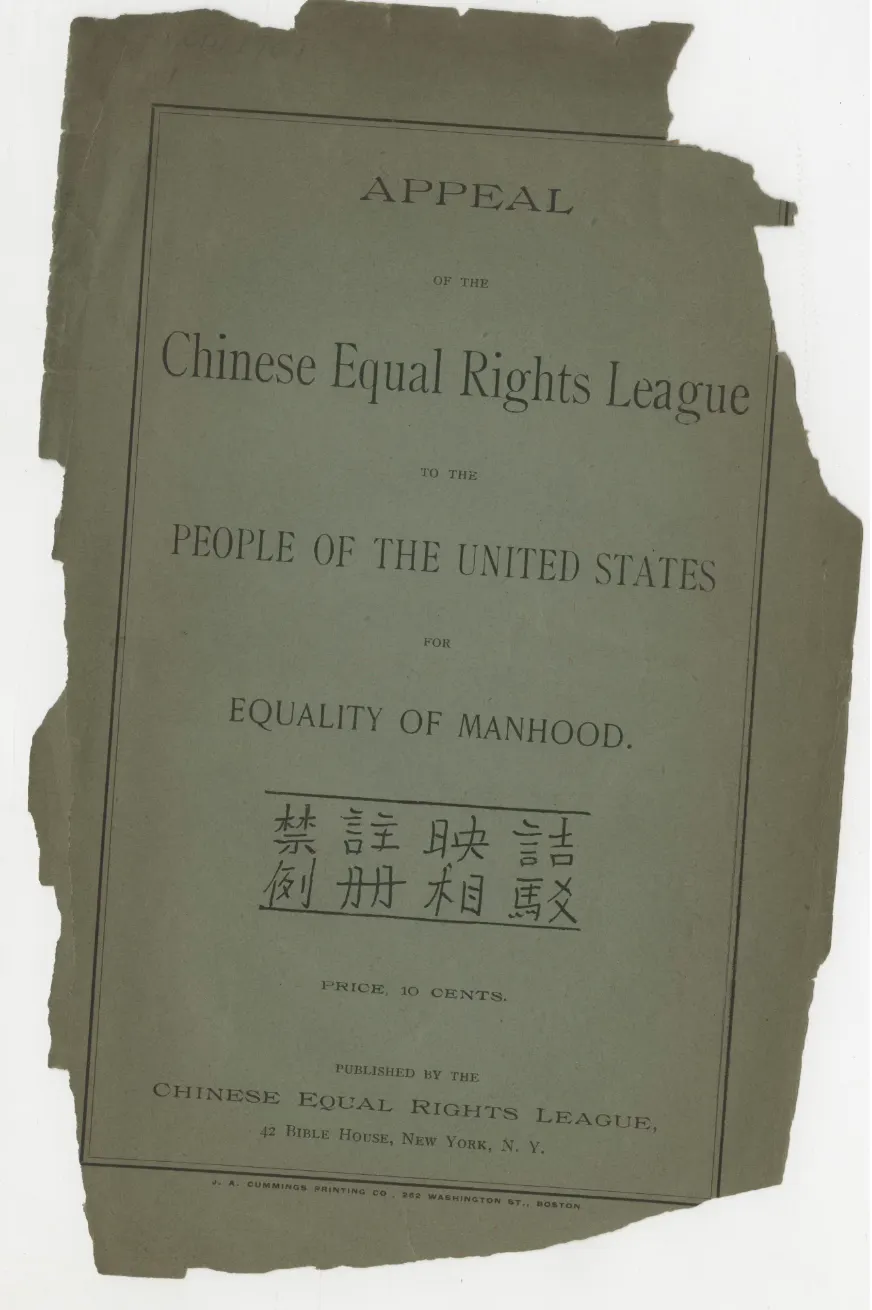
Appeal of the Chinese Equal Rights League to the people of the United States for equality of manhood. Chinese Equal Rights League. United States. New York : The League 1892. Patricia D. Klingenstein Library at The New York Historical.
We chose this primary source because it shows how Chinese people living in the United States continued to face and fight against racial discrimination despite the passage of the 14th Amendment, which guaranteed equal protection under the law through its Equal Protection Clause. The Reconstruction Era is commonly known as a time of civic and social growth for Black Americans. The Chinese, however, are not often associated with the same tale, although they too navigated and fought against systemic racism. We wanted to highlight how Chinese Americans challenged anti-Chinese sentiment by using the legal system. The Appeal of the Chinese Equal Rights League was the perfect starting point for that research.
In order to read deeply into the subtext, or nuances, of our source, we all collectively read the full appeal and also allotted time to break up the Appeal into smaller sections to analyze individually. For better historical context, we read widely regarded primary source documents from relevant organizations or people mentioned in the Appeal. These documents included the Chinese Exclusion Act and the Geary Act. We also read lesser-known primary source documents such as local newspaper clippings.
The historical research process is an incredibly multifaceted experience, mirroring a traditional scientific research process that involves an initial question followed by discovery and synthesis. Oftentimes, the analysis of a source would not only further our understanding of our research, but would also lead to more pressing questions. These questions ranged from legislation-related issues to the more humanitarian aspects of our project, making this process highly non-linear. With this process came the production of our group’s interactive digital humanities project, highlighting the humanity of the victims who had to navigate the sinophobic legal system of the time. We narrowed in on five U.S. Supreme Court cases that we wanted to highlight. We chose these five in part because they are already widely known Chinese American cases, but also because we wanted to emphasize the diversity of the litigants. Each plaintiff had his or her own unique experience and story, something we thought was very important to spotlight. During our historical research process, we encountered numerous challenges. Our biggest challenge was having to represent historical figures from an era where information can be incredibly scarce. Centering the humanity of the court cases proved incredibly difficult when basic background information about certain individuals was unknown. However, consistent in-depth research and educated, deductive reasoning allowed this aspect of our project to flourish.
Additional resources and tools that allowed for the development of our research and tech process were The New York Times’ Times Machine, an archive of their historic newspapers issued from 1851 to 2002. It served as a fundamental resource in both the research and tech side of our project. Having a direct, primary source that gave us crucial information regarding the public perception and first-hand experiences of the period was invaluable. We also used Notebook LM to help us compile our body of research information.
From our process, we identified a few tips and tricks that may be useful for other researchers. First, don’t be afraid to information dump all of your research into a doc in the early stages, even if you’re not sure how it all relates. You can always go back and organize that research into shared themes. Additionally, using the index of a source is helpful for finding relevant content in dense material. We also recommend taking advantage of the New York Public Library’s research database, as it is really helpful for finding obscure primary sources.
Over the course of the 29-weeks, we scoured dozens of primary sources related to our five court cases, spending hours on research alone. Our number one takeaway was that the Reconstruction Era was not simply a Black-and-white narrative; the struggles for equality were universal, and applied to all races. Chinese Americans did not remain oppressed in silence. Rather, they were extremely active in this transformative period. Their fight for equality ranged from openly challenging laws to forming advocacy coalitions. With our research, we, along with our readers, are able to look beyond the traditional chronicle of post-Civil War America. It is important for the American people to note the sinophobic legislation that was passed, and the subsequent public responses, in order to have a multidimensional perspective on history. Education situates people in a particular position of power and yields the opportunity for change. We want our audience to understand the context of the Chinese in the Reconstruction Era so that there can be future growth. Our hope is that our readers feel inclined to learn even more about what it looked like to play an active role in our nation’s democracy as a Chinese American. Similarly, our primary source’s history remains relevant today because debates over immigration, citizenship, racial discrimination, and belonging continue to shape public life in the United States. The Chinese Equal Rights League’s efforts demonstrate how marginalized communities resisted exclusion through collective action, legal challenges, and political advocacy. Studying these movements also challenges simplified narratives of American history by showing that many different groups contributed to the ongoing fight for civil rights, and helps expand the widely accepted binary understandings of the Reconstruction Era.
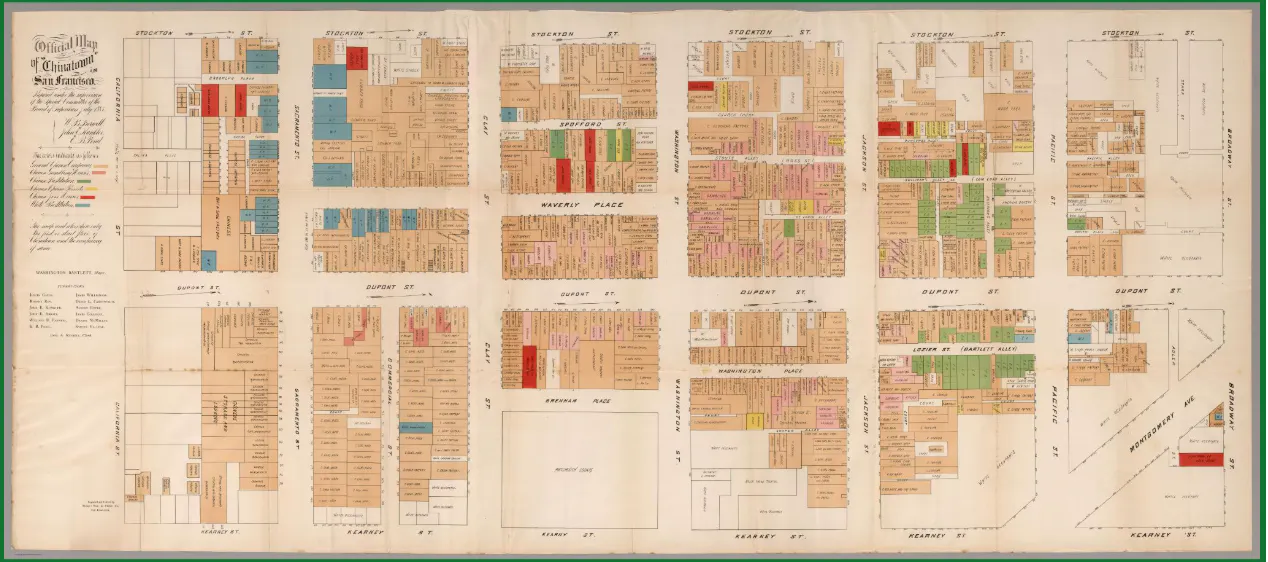
One of the interactive primary sources used in our project:
The Official Map of Chinatown in San Francisco, 1885.
This research project helped us see history as something far more interconnected and relevant to the present than we had previously realized. Learning about the Chinese Equal Rights League showed us that many issues we debate today—such as immigration policy, xenophobia, and equal protection under the law—have deep historical roots. It also changed our understanding of Reconstruction by revealing how diverse communities sought inclusion and justice during that era, even though their stories are often overlooked in textbooks. We encourage our readers to engage in this kind of historical work because it encourages critical thinking, strengthens understanding of current events, and gives voice to individuals and communities whose contributions have too often been ignored. We hope our work is both informative and inspiring, and pushes others to do research of their own.
Citations
- Appeal of the Chinese Equal Rights League to the people of the United States for equality of manhood. Chinese Equal Rights League. United States. New York : The League 1892. Patricia D. Klingstein Library at The New York Historical.
- Speech of Wong Chin Foo At the Mass Meeting of the Chinese Equal Rights League at Tremont Temple, Boston, Nov, 18, 1892.
Authors Roland Delacour, Momo Inoue, Madeleine Luo, Jenna Sirio, and Lucia Xiao are Student Historian Interns at The New York Historical.
( Originally published in The New York Historcial)
Disclaimer
Voices & Bridges publishes opinions like this from the community to encourage constructive discussion and debate on important issues. Views represented in the articles are the author’s and do not necessarily reflect the views of the V&B.