
This is part one of a two-part series on the City of Isleton, and its exemplary community engagement and resourcefulness in pursuing downtown revitalization. The second part focuses on Isleton’s participation in the Sacramento Area Council of Governments’ Rural Main Streets Technical Assistance Program, as well as its upcoming work with CivicWell and the Caltrans Sustainable Transportation Planning Grant Program.
Jean Yokotobi, the daughter of second-generation Japanese-American farmers, was born in a Northern California Japanese internment camp during World War II. While in college at San Francisco State University, she drove through the small California Delta town of Isleton in a convertible and fell in love with the riverside community. And now, thanks to her tireless work, Isleton will be home to the Asian American Heritage Park, a 0.27-acre public park honouring the history of the Chinese and Japanese immigrants who helped build the town.

A History of Exploitation and Perseverance
During the 1870s, thousands of Chinese workers were hired to build a large network of levees in the Sacramento-San Joaquin River Delta. The project converted 500,000 acres of swamp into fertile farmland, supporting the growth of the sugar beet, pear, and asparagus industries in the area. Once the project was completed, many of the workers stayed and made their home in local towns.
The Chinese Exclusion Act, passed by Congress in 1882, restricted Chinese immigration and prohibited US citizenship for Chinese immigrants. This led to an increase in demand for Japanese labour and a corresponding rise in Japanese immigration.
By the 1890s, Isleton had a bustling business district for its Chinese and Japanese American residents. Though two fires in 1915 and 1926 destroyed many of the buildings, according to the Delta Education Cultural Society, “It was quickly rebuilt and many of the original buildings are standing now…The Asians were moved to their current location, which is named the Asian American Historic District, which was placed on the National Registry for Historic Places in 1993.”
After the bombing of Pearl Harbour in 1941, Franklin D. Roosevelt authorized the establishment of internment camps for Japanese Americans and those of Japanese ancestry, regardless of citizenship. Isleton’s Japanese residents were among those forced into camps across the nation. Most of the buildings in town were soon occupied by others, and the original occupants could not recover their lost property after the war.
A Model of Collaboration and Engagement
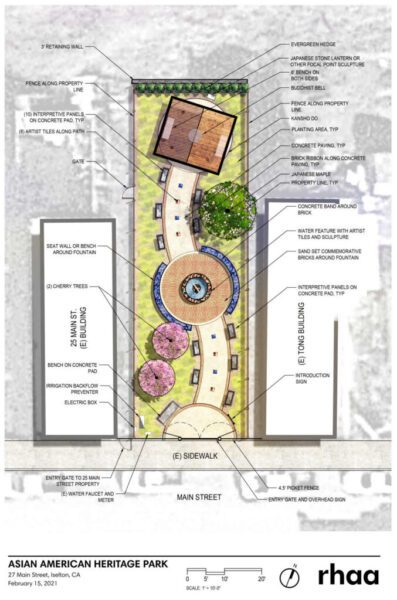
It was with this history in mind that Jean Yokotobi founded the nonprofit Delta Education Cultural Society (DECS) in 2009, and she has worked continually toward the goal of creating Isleton’s Asian American Heritage Park. The vision includes beautiful landscaping, walkways, an artistic ceramic water feature, engraved bricks and plaques recognizing contributors to the park, and a Japanese bell temple (Kansho-do).
In a setting of peace, harmony, and reflection, the park will celebrate the life and contributions of the Chinese and Japanese who once occupied Isleton’s Asian American Historic District, including events and policies that impacted them through the generations. It will help sustain the Delta’s heritage and provide education in the hope that parts of history will never be forgotten or repeated.
In 2020, Ms. Yokotobi and DECS submitted a concept proposal to the Delta Conservancy for grant funding and were invited to submit a full proposal.
Through Funding Navigation for California Communities, CivicWell’s program that provides technical assistance and a roadmap to help localities and community-based organizations pursue funding opportunities and develop competitive projects and proposals, our team assisted Ms. Yokotobi, the City of Isleton, and their grant writer in creating a competitive application.
The application was successful, and the Delta Conservancy has agreed to grant $554,000 for the creation of the Asian American Heritage Park.
Despite the challenges of limited local staff resources and funds, the project has been a model for the power of local volunteerism, collaboration, ingenuity, and perseverance.
With referrals from the Sacramento Area Council of Governments and Sacramento City Historian Marcia Eymann, DECS assembled an expert team of architects, designers, artists, and accountants who provided pro bono help.
Isleton’s local community has also played a huge role in bringing the park to life. A community advisory committee informed the educational content and secured donors for commemorative benches and walkway bricks. DECS also plans to develop a Friends of the Park program to enlist gardening volunteers from the community and continue to fundraise to support park maintenance.
Creating a Small Town Destination
The Asian American Heritage Park is part of an ongoing collaborative effort to preserve and revitalize Isleton’s downtown area. Like many small towns across the nation, Isleton has seen a drop in population and many downtown buildings are vacant. However, recently, a small cluster of new businesses has emerged, and the park is a new attraction to help tourism and economic growth in the region by drawing residents and visitors downtown.
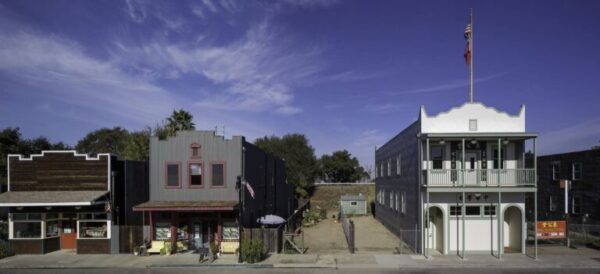
The site of the park is adjacent to the Isleton Museum, which is housed in the Bing Kong Tong building, a historic structure in a Chinese American architectural style that was originally a Cantonese language school and meeting hall. By featuring Asian artwork and interpretive exhibits, the park adds a new element to the historic Isleton Chinese and Japanese Commercial Districts.
The story of Isleton’s Asian American Heritage Park is a testament not only to the perseverance and commitment of one community leader but to the power of people coming together to transform a local vision into action. “My passion for Isleton will always remain,” shared Ms. Yokotobi. “My contribution is to see this town become the town I was introduced to in the 1960s. It has given me a sense of worth, a sense of peace, and a sense of hope for the future.”
With the forthcoming influx of infrastructure funds, now is the time for local leaders everywhere to plan for the projects they want to see, regardless of the size of their community. Programs like Funding Navigation for California Communities can help move those projects from vision to implementation.
Tune in next month for part two, where we explore the broader downtown revitalization work happening in Isleton and how you can apply those tools in your community.
- CivicWell first published the article.
Disclaimer
Voices & Bridges publishes opinions like this from the community to encourage constructive discussion and debate on important issues. Views represented in the articles are the author’s and do not necessarily reflect the views of the V&B.