
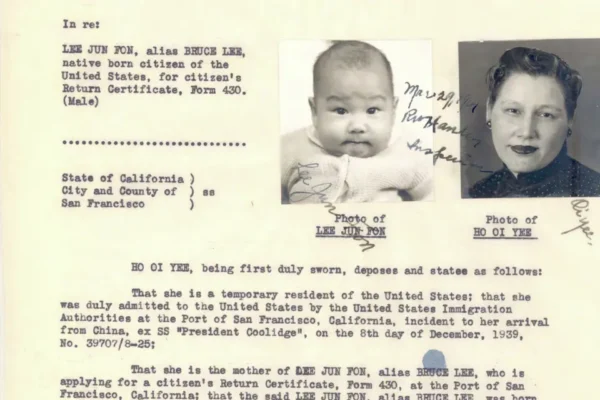
Bruce Lee’s mother declares that she is a temporary resident of the U.S. in a document in the National Archives collection in San Bruno.
National Archives
By Harry Mok
Anna Eng knew from family lore that her great-great-grandfather died in a mining accident in Nevada during the late 1800s. What was lacking were details.
“For nearly five generations, even though it was part of the family oral history, we never knew the exact location of where it was, where it happened,” Eng told me.
Eng, a historian, also knew that there would likely be immigration records of her ancestors and answers at the National Archives and Records Administration’s facility in San Bruno. Her research unearthed her great-grandfather’s immigration file, including a transcript of his interrogation to determine if he could enter the U.S. under the Chinese Exclusion Act of 1882.
“He describes in detail, as a 14-year-old, what happened with the circumstances of his father,” Eng said.
Her great-great-grandfather was working at a mine in 1890 near Lovelock, Nev., where he died in a cave-in.
“It’s like excavating the bones of the past,” Eng said. “The emotions. I can’t describe how moving it is to be able to even hold the piece of paper … it is like creating wholeness.”
For many Chinese Americans like Eng, who want to know their family history, researching the archives in San Bruno has unlocked mysteries that have been buried for decades. More than family histories, the archive is a record of the origins of the Chinese story in America, and offers valuable insights into a dark period of U.S. history that should not be forgotten.
But Bay Area residents could soon lose access to the treasure trove of information.
The National Archives and Records Administration plans to close the San Bruno facility along with one in Chicago and relocate records, a move that could begin “within the next few months,” according to a KQED report about an email sent to the agency’s staff.
The San Bruno archive includes immigration files on Bruce Lee and documents from Wong Kim Ark’s 1898 Supreme Court case, which set the legal precedent for birthright citizenship. Federal immigration, court and genealogical files, ship manifests, Alcatraz inmate files and records on Native American tribes are also in the archive. Many of the artifacts are fragile or can’t easily be digitized.
No timeline for a move or plan for where the San Bruno archive would be transferred to has been made public. My inquiry to the National Archives and Records Administration about the relocation went unanswered.
Eng is a member of Save Our National Archives, which is organizing a letter-writing campaign to advocate for keeping immigration records in San Bruno. The group was founded to oppose a previous attempt to move them in the late 1990s.
“It’s tremendously important for the local communities to have access to these materials,” Eng said.
In particular, the records from the Angel Island Immigration Station, where Chinese immigrants or those returning to the U.S. were held and questioned, often for weeks, under the Chinese Exclusion Act until it was repealed in 1943. The law forbade women and laborers and limited immigration to the merchant class and others of higher social status.
This might be fodder for anti-immigration zealots, but during the exclusion era, many Chinese immigrants, merchants or not, entered the U.S. as “paper sons.” They memorized family ties to a father or uncle to whom they were not related and details about a village in China they may not have lived in. They did this to circumvent a racist law and pass through Angel Island, where authorities kept detailed records of immigrants and used the information to question those entering the country to ensure they weren’t undesirable.
The records in San Bruno are invaluable for many participants in the Roots: Him Mark Lai Family History Project. The genealogy program helps people trace their family’s origins and culminates in a trip to their ancestral homes in Guangdong Province in southern China, where most Chinese immigrants to the Bay Area and the U.S. originated from until the 1980s.
The records kept by immigration authorities were also unwittingly a genealogical history for the thousands of families whose ancestors went through Angel Island. Information such as entry dates to the U.S, family trees, the names of ancestral villages and such minutiae as where homes were located in villages was documented, and officials also collected items such as wedding certificates and photos.
“This is really, really specific kind of data. It doesn’t really exist elsewhere,” Brian Yee, president of Roots project, told me.
Families researching their history may come upon a photo of a relative they’ve never seen before in the San Bruno archive.
“A family’s personal life is just documented and out there in some public record,” Yee said.
Plans to relocate the San Bruno archives might be a budget-cutting move, but it’s happening when the Trump administration seems bent on whitewashing U.S. history.
Losing access to the records in San Bruno would limit the opportunities for many children of immigrants to learn about what their parents went through to come to the U.S.
Family histories are often a blank slate, something not talked about or easily understood. Learning about your family’s history does trigger the “wholeness” that Eng felt.
I experienced it after visiting the tiny villages where my parents were raised in the Enping area of Guangdong, and I saw it in participants of the Roots program when I followed them to China in 2000 for a Chronicle story.
Eng is right: It is hard to describe, but once you’ve learned about or seen where your parents or grandparents came from, it gives you an appreciation for their perseverance in providing for their families even when immigrating to a country that doesn’t want them. It strengthens your sense of identity against racism that’s still too common. It is a reminder that this country is made up of immigrants and that their stories are as American as anyone else’s.
( Originally published in San Francisco Chronicle )
Disclaimer
Voices & Bridges publishes opinions like this from the community to encourage constructive discussion and debate on important issues. Views represented in the articles are the author’s and do not necessarily reflect the views of the V&B.