
By Isabelle A. Lu, Crimson Staff Writer
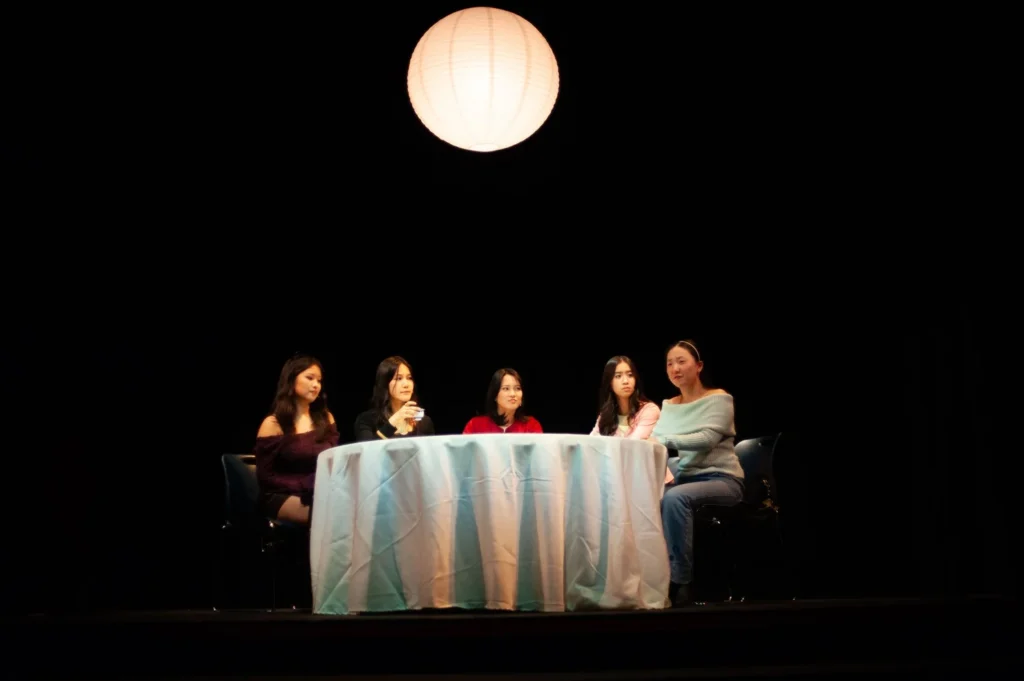
Sharing stories of growing up over a dim sum meal: It’s not such a surprising concept — in fact, it feels warm, familiar. There’s also something unplaceably familiar about the title “Asian Women I Know,” and, as one might guess, the play is semi-autobiographical. Taking its title from a real-life group chat of five Asian American women at Harvard — including writer Mira H. Jiang ’26 and director Crystal X. Manyloun ’26 — the Asian Student Arts Project-presented production is based on the group’s very outing to Boston’s Chinatown.
When five women — Jasmine (Phoebe Zhang ’26), Vivien (Grace M. Liu ’26), Anna (Maggie J. Peng ’28), Kitty (Kaitlyn Mady ’29), and Star (Grace H. Zhou ’28) — sit down at a dim sum restaurant, they wind up talking about everything from eating habits to stereotypes to family pressures. As they strive to break free of others’ expectations, the play attempts to do the same with its representation of Asian American women. Thoughtful and funny, “Asian Women I Know” found strength in its ability to hit home for Asian American audiences — yet it also managed to teach its audience something new.
Reenacting a series of vignettes over the course of one meal, “Asian Women I Know” juggled multiple elements: relatability, humor, and enlightenment. The five characters are Laotian, Chinese, Vietnamese, and Korean, with different personalities and concentrations. In choosing and crafting what stories to tell, the play had to balance the constraints of the autobiographical with the goal of broader representation.
“Classic” Asian American experiences — a competition between cousins, spurred on by their mothers or the craving for belonging in a predominantly white high school — took on energizing novelty through the vignettes’ stagings. For example, one scene depicting parallel Science Olympiad and cheerleading experiences connected the drastically different women Vivien and Kitty. The scene showcased how the struggle to become exceptional is often intertwined with the desire to attain social acceptance — yet it recognized how this acceptance can come at a cost.
Adding crucial nuance to this notion was the play’s attention to historical context. Weaving in stories of the U.S. bombing of Laos between 1964 and 1973, the 1989 Chinese pro-democracy protests, and American distrust of Chinese Americans’ national loyalties, Jiang portrayed how family-imposed pressures fall in line with social expectations as consequence of broader political forces. These inclusions successfully added complexity to a worldview that could have been limited by how personal it was.
While connecting different characters’ experiences, “Asian Women I Know” also took care to explore that there is no such thing as a unified Asian American experience. Through conversation in between vignettes, the women admitted the tensions they felt internally and in their relationships with each other. While they threw out the overly stereotyped expectation of “getting good grades” as part of their shared Asian American experience at the meal’s start, Jasmine’s story about being the first in her Laotian family to attend college refreshingly challenged that stereotype.
Indeed, the scenes that shone most were the ones that broke beyond already-typified Asian American stories. The most memorable vignette, led by Jasmine, started off with a bang — with a giant notepad reading “History of the ABG,” an abbreviation of Asian Baby Girl, a term used to describe Asian American women who present a Westernized cosmetic and social style, and that draw aesthetic inspiration from other communities of color — and ended with a ukulele interlude as Zhang sang “Who you callin’ your ABG?.” While many encounter the ABG subculture through internet jokes, “Asian Women I Know” demonstrated just how much we have to educate ourselves — relaying ABGs’ lesser-known relationship with other communities of color, their rejection of imposed stereotypes of the passive Asian woman, and their simplification in contemporary pop culture.
Still, it’s a difficult task to completely break free of expectations in a one-act, personal play. At the least, the depiction of characters other than the central, young Asian American women could’ve been more complex. While the douchebag white boyfriend, two-faced cheerleading teammate, and stiflingly critical Asian mom made for punchy storytelling, the play could have granted them more realistic moral nuance — exploring how the psychological harm done to Asian American girls is often insidious rather than blatant.
Ultimately, whether its stories felt familiar or eye-opening, “Asian Women I Know” was clearly made with heart for a particular audience. Its references enhanced comic moments and kept up a buoyant pace — such as in Anna’s story about her mother suspecting her of dating a white boy, because of information spread through a Harvard parents’ WeChat group, which culminated in the exclamation: “I don’t care if you date a white boy, just as long as he isn’t a humanities major!” Another highlight was the quippy exchanges in Mandarin between Vivien and the feisty older waiter (Michael Xiang ’26), transitioning between vignettes with humor that hit home.
The humble yet elegant production design anchored the show’s comfortable intimacy, becoming an invitation to communal experience. While the five women sat around a table, a handful of audience members sat at tables in front of the stage and were served fortune cookies during the final scene. (Everyone else, fortunately, had the opportunity to buy egg tarts at the door.) Ending on a sense of shared food and shared hope, “Asian Women I Know” did more than recreate Asian women’s experiences on the stage — it drew out the potential for mutual understanding by speaking out and sharing our stories.
“Asian Women I Know” ran at the Agassiz Theatre from March 25 to 29.
(By The Harvard Crimson)