
By Shen Guanlan May 1, 2026
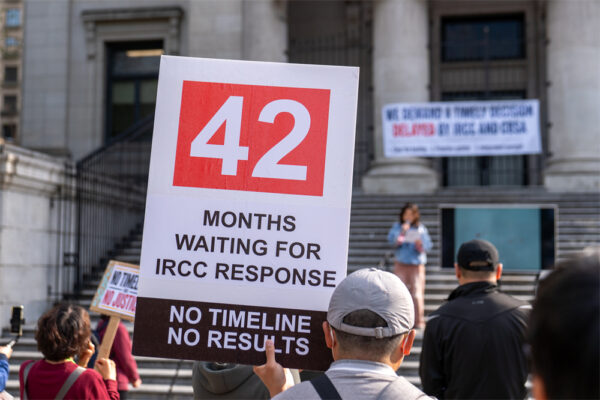
On the morning of May 1, 2026, hundreds of people gathered at the Vancouver Art Gallery Square in downtown Vancouver. They came from across Canada—British Columbia, Alberta, Ontario, even as far as the Atlantic coast—taking time off work and flying thousands of kilometers on a weekday, all to voice a common demand: their lives should no longer be delayed indefinitely.
This was a protest against Canada’s immigration system. Most participants were permanent residence (PR) applicants, though some were Canadians who already held PR cards or even citizenship. Their shared experience: their PR applications, or family reunification immigration applications and visas they had filed for relatives, had been trapped for years in what is known as “security screening.” Wait times have stretched from two or three years to over five. While official processing standards are stated in months, in reality some applicants have been waiting nearly five years—far beyond any reasonable limit.
“We’ve been thrown into a black hole with no exit,” one speaker said at the scene.
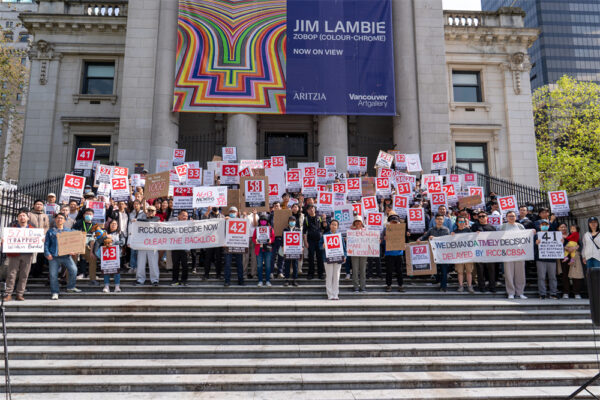
Behind these numbers are lives that have been interrupted. Some have been unable to see their dying fathers. Some, due to uncertain status, have been forced to have their children pay exorbitant international student tuition fees. Some have lost their marriages while waiting. Others, unable to obtain permanent status, have had to put entrepreneurship, employment, and even basic life planning on hold.
One doctor at the protest shared her story: she came to Canada to participate in the healthcare system and to found a medical device company, but during the four years she waited for her PR approval, she was never able to secure investor support. “Without status, there is no future,” she said.
Another participant described an even heavier cost. She had been in a serious car accident, subsequently lost her job, and fell into post-traumatic stress disorder (PTSD). But because her parents’ visas were stuck in the immigration system, she could not be reunited with her family during her most difficult moments. “I almost died alone,” she said.
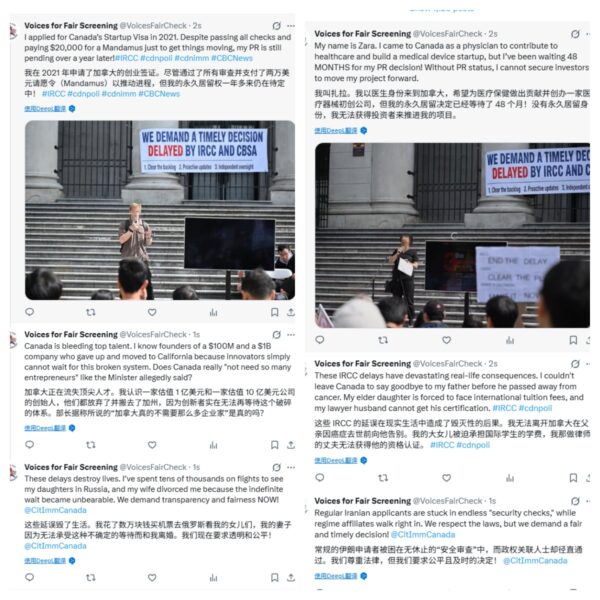
Similar stories surfaced repeatedly in the speeches. One person had waited 571 days without any substantive update, receiving only template responses saying their case was “in process.” Another could not return home to visit a critically ill relative during the wait, because leaving Canada could mean being unable to re-enter. Yet another said she felt “as if I’m shouting into the void”—after years of contacting the government, MPs, and even filing freedom of information requests, she always received the same answer.
These experiences are not just individual—they are becoming a collective phenomenon. Protest organizers pointed out that tens of thousands of families have already been affected by prolonged security screening delays. Many applicants exist in a gray zone of “legal residence but unable to live stably.” They can work and pay taxes, but they cannot access full social rights, nor can they make basic plans for the future.
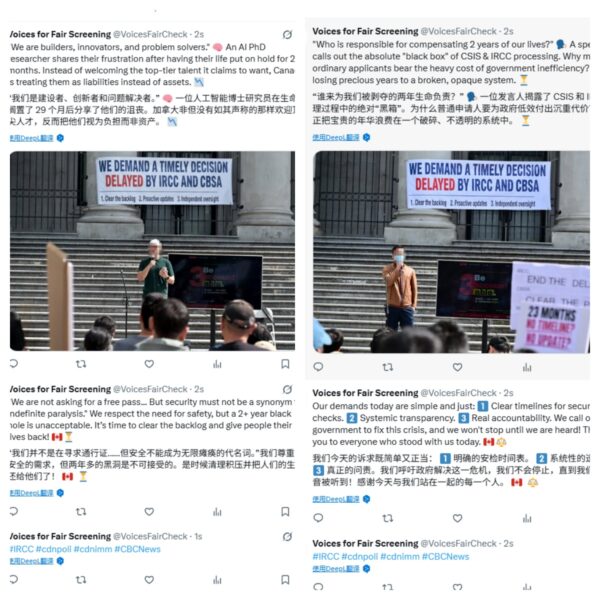
What’s even more concerning is that this problem is producing a chain reaction. Some highly skilled talents, including entrepreneurs and tech professionals, have chosen to leave Canada for the United States, the United Kingdom, or Australia. In the context of global competition for talent, this kind of brain drain is weakening Canada’s own appeal.
Signs at the protest read: “We demand a timely decision.” This is more than a slogan—it is a direct challenge to the system. Participants broadly agree that “security screening” has evolved from a reasonable background check into a tool of administrative delay lacking transparency and time limits. Data shows that only a tiny minority of cases are ultimately found to involve security concerns, yet the vast majority of applicants remain stuck in the review process for years.
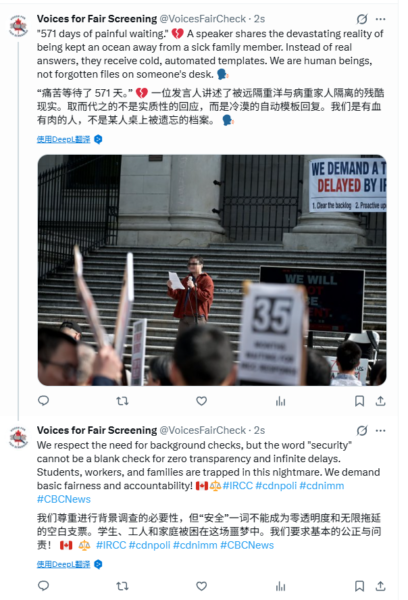
On the steps of the plaza, one speaker asked the crowd: “Thirty months have passed—have they still not decided whether I’m a threat to national security?” The crowd responded in unison, loud and clear: “No!”
The protest’s demands centered on three points: first, establishing legally binding caps on processing times; second, providing regular and transparent progress updates; third, creating an independent oversight mechanism to ensure the immigration system is accountable to applicants. These demands may seem technical, but they go to the heart of the system—who holds the power, and who bears the responsibility.
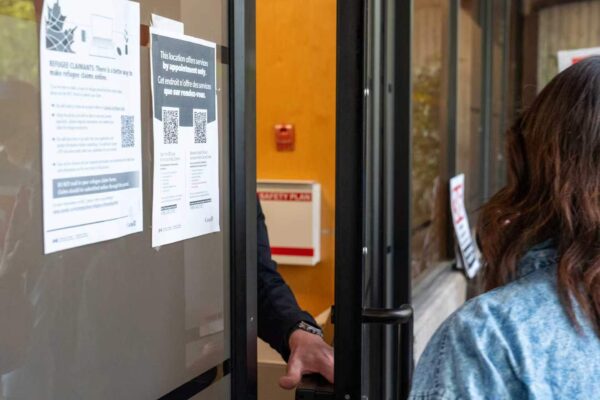
At the end of the event, participants walked from the Vancouver Art Gallery square to the Vancouver immigration office to deliver a formal letter, demanding that the government respond to the delay problem. “We’re not here to cause chaos,” one organizer said. “We just want to be seen and heard.”
The significance of this protest may extend beyond immigration policy itself. It reflects what happens when a system loses its sense of time: people’s lives lose certainty along with it. When waiting no longer has an end, the individual is no longer simply an applicant, but a life put on pause.
In an era of ever-increasing global mobility, immigration is not just a policy issue—it is a question of family, dignity, and belonging. The Vancouver gathering reminds us: every delay in the system affects not paperwork, but a real human life. And as more and more people take to the streets to speak out, this “waiting” is being transformed into a public issue that must be answered.