
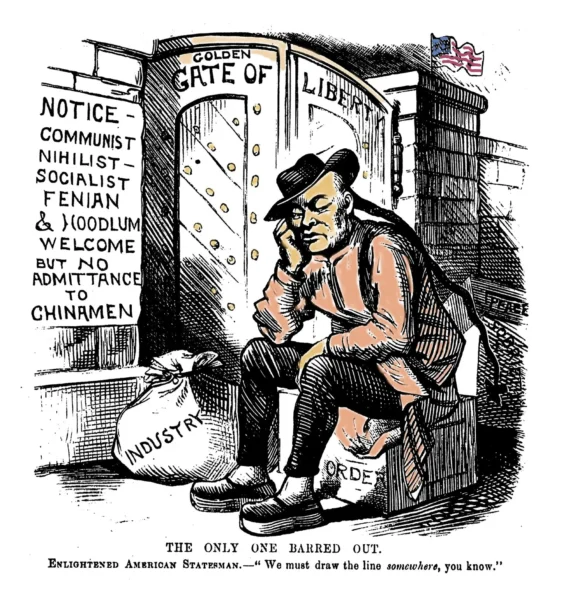
 The only one barred out. “We must draw the line somewhere, you know,” 1882. Private Collection. Artist Anonymous. The Trump administration is defending the 1882 Chinese Exclusion Act against the charge that the law had a racist intent. (Photo by Fine Art Images/Heritage Images via Getty Images)
By Randall Yip
The Trump administration is defending the 1882 Chinese Exclusion Act which made Chinese the first group in the nation’s history excluded from the country based solely on their race.
The defense of the act comes in a report released July 4th entitled Saving America’s Story: How Ideological Capture at the Smithsonian Institution’s National Museum of American History Erases Our Heritage.
The report is a highly critical look at the Smithsonian’s interpretation of American history in its exhibition, particularly at the National Museum of American History.
It says its exhibitions “portray restrictive immigration laws as a tool of White supremacy. The Many Voices, One Nation
didactic entitled “Negotiating Inclusion” alleges that when “thousands of Chinese journeyed to the American West, encouraged by the promise of gold rush opportunity” in the 1850s, “[t]heir race…troubled white Americans,” leading to the 1882 Chinese Exclusion Act, “the first of many restrictive immigration laws.” Another states, “White laborers considered the Chinese competition and responded with hostility.”’
The White House prefaces the report by accusing the Smithsonian history museum of depicting American history as defined by “White supremacy, slavery, conquest, exclusion, hierarchy, racism, xenophobia, misogyny, and systemic injustice.”
Eunice Kwon of the Asian American Research Center at UC Berkeley called the White House report a step backwards.
“Congress expressed formal regret for the 1882 Chinese Exclusion Act more than a decade ago, unanimously and across party lines,” said Kwon in an email statement to AsAmNews. “For this administration to reverse course and defend this explicitly racist law tells Asians and Asian Americans that our rights and our humanity in this country are negotiable. The effort to rewrite that history, to erase the racial hostility and the violence that Chinese immigrants actually faced, and to recast exclusion as an economic dispute, is dangerous for our communities. It provides cover for a present-day agenda built on the same tropes about Asian, African, and Latin American societies: a refugee ban that admits almost no one except white South Africans, entry barred from dozens of Asian and African countries, and the inhumane separation of migrant families and children.”
David Lei of the Chinese Historical Society of America did not appear surprised by the White House report.
“I am numb to all the White House antics,” he said while acknowledging that he “shouldn’t be.”
He says CHSA has a bank account he described as “healthy,” but has chosen to severely cut back on its staff to focus on “researching and gathering Chinese American stories to be available to researchers and the general public.
“We can continue to do this without funding or interference from the government…In the past 15 months CHSA has transformed into a mostly volunteer organization without an executive director nor high paying staff.”
( Originally published in AsAmNews )
Disclaimer
Voices & Bridges publishes opinions like this from the community to encourage constructive discussion and debate on important issues. Views represented in the articles are the author’s and do not necessarily reflect the views of the V&B.