
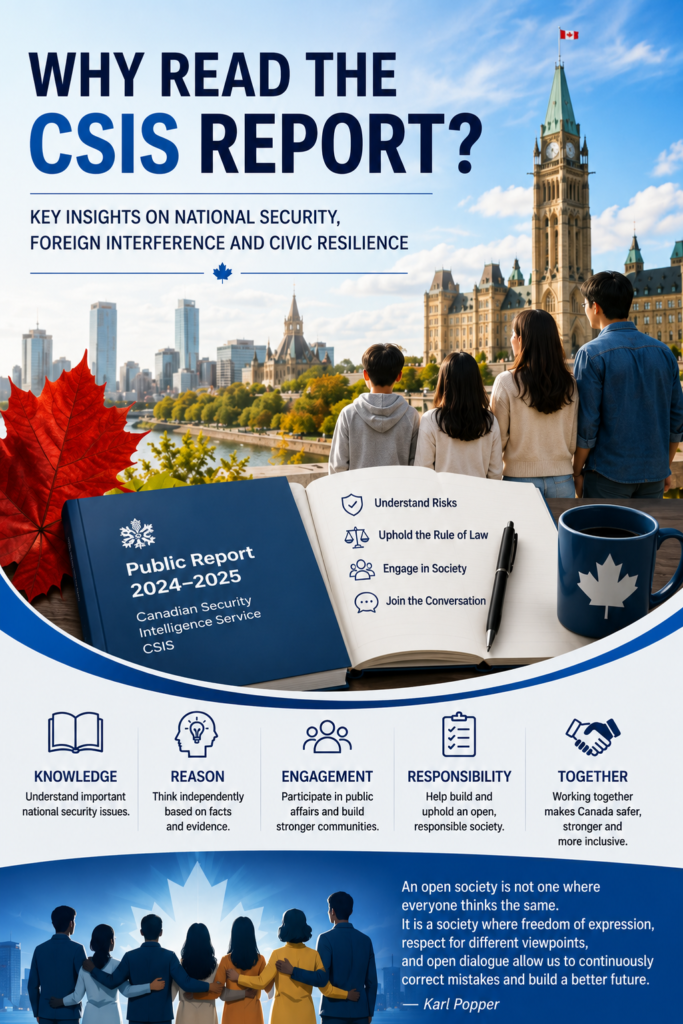
In recent years, foreign interference has emerged as one of the most prominent and widely debated issues in Canadian public discourse. From media coverage and parliamentary hearings to the passage of Bill C-70, An Act Respecting Countering Foreign Interference, and the creation of the Foreign Influence Transparency Registry, matters once confined to national security professionals have increasingly entered the public sphere.
At the same time, public debate surrounding foreign interference has become more polarized. Some argue that foreign interference poses a significant threat to Canada’s democratic institutions and public trust. Others contend that the issue has been overly politicized and may contribute to misunderstanding, suspicion, or even the stigmatization of particular ethnic communities. In the age of social media, citizens are constantly exposed to fragmented and often conflicting information: news headlines, online commentary, anonymous allegations, political statements, inquiry hearings, and reports published by advocacy organizations, think tanks, and government agencies. Unsurprisingly, many people find it difficult to separate fact from speculation and evidence from opinion.
Against this backdrop, an important question arises: If we genuinely want to understand what Canada’s national security institutions are concerned about, where should we begin?
The answer may be simpler than it appears: read the original documents.
The Canadian Security Intelligence Service (CSIS) publishes an annual Public Report and regularly releases educational materials on topics such as foreign interference, economic security, espionage, cybersecurity, and transnational repression. These publications are not infallible, nor should they be regarded as the final word on any issue. However, they represent the official assessments of Canada’s primary civilian intelligence agency and provide an important starting point for understanding how national security risks are identified, analyzed, and communicated within the Canadian system.
To appreciate the significance of these reports, it is useful to understand the unique role that CSIS plays within Canada’s national security framework. CSIS was established in 1984 following the recommendations of the McDonald Commission, which investigated the activities of the former RCMP Security Service. The Commission concluded that intelligence collection and law-enforcement powers should not be concentrated within a single organization. As a result, Canada separated national security intelligence functions from criminal policing. CSIS became responsible for collecting and analyzing intelligence related to threats to Canada’s security, while criminal investigations and law enforcement remained the responsibility of the Royal Canadian Mounted Police (RCMP).
This institutional arrangement reflects a fundamental principle of Canada’s democratic system: an intelligence assessment is not the same as a judicial finding.
In fact, this distinction is often overlooked in public discussions about national security.
In democratic societies governed by the rule of law, different types of information carry different evidentiary weight. Court decisions, police investigations, intelligence assessments, media reports, and public allegations may all concern the same event, but they do not carry the same level of authority or certainty. If we think in terms of evidentiary strength, these sources can broadly be understood as falling into four levels.
At the highest level are Court Findings. These are facts established through judicial proceedings involving evidence, witness testimony, cross-examination, legal argument, and a formal ruling by a judge or court. In a rule-of-law society, court findings carry the greatest evidentiary authority because they have been subjected to rigorous procedural safeguards and standards of proof.
The second level consists of Criminal Charges or Official Investigative Findings. This category includes criminal charges laid by law-enforcement agencies, findings issued by commissions of inquiry, or formal reports resulting from government investigations. Such findings are typically based on substantial evidence and investigative work, but they do not necessarily represent final legal determinations.
The third level consists of Government or Intelligence Assessments. Much of the information released by CSIS, the RCMP, Canada’s Five Eyes partners, and other national security organizations falls within this category. Intelligence agencies are tasked with identifying risks, assessing threats, and providing decision-makers with information relevant to national security. Consequently, their reports frequently use language such as assesses, believes, judges, or has concerns. These assessments can be highly valuable and may be based on information unavailable to the public. Nevertheless, they should not be confused with facts that have been established through judicial proceedings.
The fourth level consists of Media Reports, Allegations, and Leads. Such information often serves as the starting point for further investigation. Journalistic reporting can play a vital role in bringing important issues to public attention, but media reports, anonymous sources, allegations, and tips are not, by themselves, proof of wrongdoing. Their accuracy and completeness require further verification.
Developing an awareness of these different evidentiary levels is particularly important when discussing foreign interference.
In recent years, debates surrounding foreign interference, transnational repression, and so-called “overseas police stations” have drawn on information from many different sources, including media reports, academic studies, NGO publications, intelligence assessments, police investigations, and legal proceedings. Without an understanding of evidentiary hierarchy, it becomes easy to conflate fundamentally different kinds of information. Some may assume that anything appearing in an intelligence report has already been proven as fact. Others may dismiss all concerns simply because a matter has not yet resulted in criminal charges or a court ruling. Both approaches are overly simplistic.
A mature democratic society requires both risk awareness and evidentiary awareness. Risk awareness means taking seriously the warnings and assessments issued by national security institutions. Evidentiary awareness means recognizing that assessments, suspicions, concerns, and allegations are not equivalent to proven facts.
For Chinese Canadians, this distinction is particularly important.
In recent years, the Chinese Canadian community has often found itself at the center of discussions about foreign interference. On the one hand, the People’s Republic of China has been one of the most frequently discussed countries in recent CSIS reports. On the other hand, Canada is home to more than 1.7 million people of Chinese origin, representing a highly diverse community with a wide range of political views, cultural backgrounds, personal experiences, and social perspectives.
Many Chinese Canadians maintain cultural, familial, linguistic, or economic ties with China while simultaneously participating fully in Canadian society. They care about Canadian issues and may also take an interest in developments in China. Such realities are entirely normal in an immigrant society and should not, in themselves, be viewed as suspicious.
However, without an understanding of institutions and evidence, public discussion can easily drift toward two unhelpful extremes.
One extreme is to dismiss all concerns about foreign interference as political manipulation or anti-China sentiment. The other is to regard all cultural exchanges, community organizations, business relationships, or connections with China as inherently suspect. Neither approach contributes to rational public discourse.
A careful reading of CSIS publications—including Foreign Interference and You, Public Report 2024, and Public Report 2025—reveals that their primary focus is not ethnicity but behaviour. Foreign interference concerns activities that are clandestine, deceptive, or coercive. Transnational repression concerns harassment, intimidation, threats, and efforts to silence individuals beyond a state’s borders. Information manipulation concerns coordinated efforts to spread disinformation or influence public opinion through deceptive means. None of these issues are inherently linked to a person’s race, language, ethnicity, or cultural heritage.
At a deeper level, the value of reading CSIS reports extends beyond understanding specific security risks. It also helps us understand how an open society functions.
In The Open Society and Its Enemies, twentieth-century philosopher Karl Popper argued that no individual, organization, or government possesses a monopoly on truth. Every idea may be challenged, every policy debated, and every public decision subjected to scrutiny. Open societies depend upon freedom, pluralism, trust, and the ability of citizens to engage in public discussion.
Yet these same strengths can also create vulnerabilities. A society built on trust may be exploited through deception. A society committed to free expression may be targeted by disinformation campaigns. A multicultural society may face attempts by foreign actors to exploit community relationships or social divisions for political purposes.
For this reason, Popper famously described what he called the Paradox of Tolerance: a society that is entirely unwilling to defend the principles of openness may ultimately lose the ability to remain open.
Viewed from this perspective, contemporary discussions by CSIS regarding foreign interference, transnational repression, and information manipulation are not arguments against openness. Rather, they are efforts to preserve the conditions that allow openness to exist. The concern is not cultural exchange itself, nor legitimate international connections, but activities that seek to undermine democratic processes and public debate through clandestine, deceptive, or coercive means.
Importantly, these reports do not require citizens to accept a predetermined conclusion. Instead, they provide insight into how Canada’s national security institutions assess risks and identify threats. Citizens remain free to question, debate, or criticize those assessments. However, such discussions are most productive when grounded in an understanding of the original materials rather than media headlines, online rumours, or partisan assumptions.
For the Chinese Canadian community, this perspective carries particular significance. Understanding how Canada’s national security system operates, recognizing the distinction between intelligence assessments and judicial findings, and appreciating the difference between foreign interference and legitimate cultural exchange can help communities avoid both unnecessary fear and unwarranted denial of risk.
A healthy community is not merely a cultural community; it is also part of civil society. Community building involves more than preserving language, celebrating traditions, and maintaining social networks. It also involves understanding Canadian institutions, participating in public affairs, voting, developing volunteers, building community organizations, and working collaboratively with other communities.
Whether helping newcomers understand Canada’s three levels of government, encouraging eligible residents to vote, strengthening relationships between community organizations and public institutions, or fostering civic participation among younger generations, these activities may appear unrelated to national security. In reality, they contribute directly to community resilience.
Communities that understand institutions, know the rules, and actively participate in public life are generally less vulnerable to disinformation, manipulation, and external influence. By contrast, communities that remain isolated from broader civic life may find their capacity for independent judgment and public influence diminished.
Protecting an open society, therefore, is not solely the responsibility of government agencies. It is also the responsibility of citizens. National security is not only about preventing threats; it is also about cultivating a civil society capable of independent judgment, civic engagement, and democratic participation.
For Chinese Canadians, the challenge is not to choose between security and multiculturalism. Rather, it is to uphold the principles of freedom, openness, and the rule of law while maintaining cultural confidence and actively contributing to Canadian society.
As Karl Popper observed, an open society is not one in which everyone shares the same opinion. It is a society in which people are free to hold different views within a framework of peace, liberty, and the rule of law, and where errors can be corrected through open discussion.
In the years ahead, issues such as foreign interference, transnational repression, economic security, and information manipulation will continue to influence Canadian public policy and public debate. Faced with these complex questions, the most important task is not to take sides prematurely, but to develop a civic mindset grounded in facts, evidence, institutional understanding, and critical thinking.
That, ultimately, is the most important reason to read CSIS reports.
They do not replace independent thought—but they can help us begin thinking more clearly.