
Why our diverse representatives must overcome their current timidity and confidently champion their communities' unique needs as co-builders of Canada.
I was recently tidying up my study (a dangerous activity for any man of a certain vintage, as it inevitably leads to hours of reminiscing instead of actual cleaning) when I came across a booklet from 1995. It was titled Reflections of Candidates, a report published by the Chinese Canadian Association of Public Affairs (CCAPA) that summarized a post-election campaign debriefing conference, for which I had the privilege of serving as moderator.
Looking at the yellowed pages, and then looking at the mirror to confirm that my hair has indeed migrated from my scalp to other, less conspicuous places, I was struck by the “Foreword” I wrote all those years ago. In it, I quoted Niccolò Machiavelli’s famous archer metaphor: the notion that a prudent man, when aiming at a distant target, must aim a good deal higher than his objective, not because he expects his arrow to fly so high, but so that by aiming high, he might actually hit his mark.
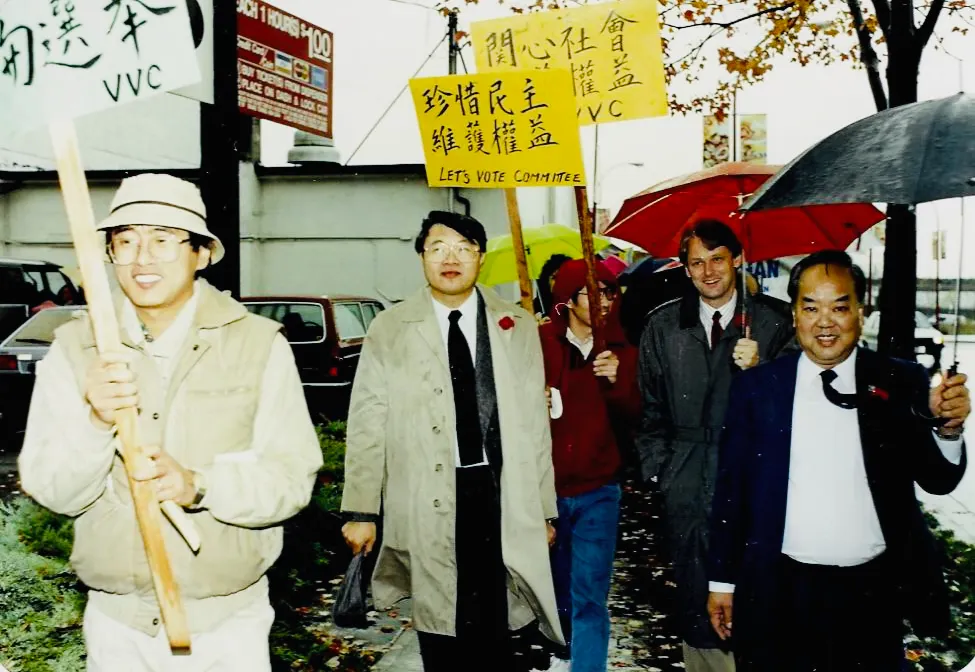
In 1995, we asked a handful of brave, first-generation immigrants who had stepped forward to run in the preceding provincial and federal elections, including the watershed 1993 federal campaign, to reflect on their experiences. Most of these candidates were adult immigrants who had spent their formative years in entirely different political environments. For them, running for office was a dramatic, sometimes challenging awakening.
In that Foreword, I wrote:
“In the purest of senses, they are saying unequivocally to Canadian society that they want to be part of the governing elite. They want to be part of the process rather than staying on the sidelines as spectators. They want to be a part of the process rather than just a part of the equation.”
More than three decades have passed since those early pioneers took up their bows. As I look around British Columbia, I find myself asking: how high did our arrows fly? Have we truly joined the common “process” of Canadian nation-building, or have we simply become a more complicated variable in the political “equations” of campaign strategists?
Have we truly joined the common ‘process’ of Canadian nation-building, or have we simply become a more complicated variable in the political ‘equations’ of campaign strategists?
The Demographic Evolution: From Pioneers to Integral Partners
To understand how far we have come, one must look at the landscape. In the mid-1990s, when we sat around meeting rooms at S.U.C.C.E.S.S. plotting how to encourage basic civic participation, the Chinese-Canadian community was a much smaller thread in the national tapestry.
According to Statistics Canada’s recent analytical portrait, the Chinese-heritage population in Canada has grown significantly over the last quarter-century, rising from roughly 860,000 in 1996 to over 1.7 million today. In British Columbia, the evolution has been remarkable. Metro Vancouver is now home to nearly half a million Chinese Canadians, representing nearly a fifth of the region’s total population. In municipalities like Richmond, we constitute a majority of over 54 percent, and in Burnaby, more than a third.
Back in 1995, if a candidate of Chinese heritage ran for office, it was treated as a novelty: a brave experiment in municipal multiculturalism. Today, if you look at a ballot in Vancouver, Richmond, Burnaby, or a provincial riding list, you will see Canadians of Chinese heritage running under every major political banner.
They are no longer running as “ethnic candidates” in isolated niches; they are running as broad-based contenders debating housing, transit, healthcare, and economic growth. This is exactly what we aimed for: a mature democracy where our public representation naturally reflects the demographic reality of our neighbourhoods. Yet, as any seasoned archer knows, hitting the target is not merely a matter of releasing more arrows; it is about adjusting for the wind. And lately, the wind has become rather turbulent.
Calibrating the Democratic Wind: Overcoming Suspicion with Transparency
If the media coverage of the 1990s was sometimes culturally naive, it was, at its core, generally encouraging of our community’s political awakening. Today, however, that early optimism is occasionally overshadowed by a heavy cloud of geopolitical tension and domestic anxiety.
The political and media discourse surrounding foreign interference, amplified by national inquiries and a steady stream of intelligence leaks, has created a difficult environment for Canadians of diverse backgrounds. There is a legitimate, vital interest in protecting the integrity of our democratic institutions from any external manipulation. Every Canadian, regardless of where they or their parents were born, has a stake in defending our sovereignty.
However, a constructive skeptic must also ask: What is the cost when security concerns are expressed in a manner that casts a wide net of suspicion over entire diaspora communities?
Too often, candidates of Chinese heritage face an unspoken, unfair double standard regarding their loyalties. It is deeply discouraging to watch young, idealistic Chinese Canadians hesitate to volunteer for a local campaign or step forward for a political office because they fear their heritage will be viewed through a geopolitical lens rather than a civic one. Or they are discouraged by their parents to step forward because of their parents’ fear for the mistreatment of their children in the process, because of their country of origin. When we allow security concerns to cast a blanket of suspicion over an entire diaspora, we weaken our own democracy from within by silencing our own citizens.
When we allow security concerns to cast a blanket of suspicion over an entire diaspora, we weaken our own democracy from within by silencing our own citizens.
I am reminded of a long-winded email I sent to the senior editor of a newspaper years ago, complaining about how his paper ignored the quiet, grinding work of minority campaign volunteers while occasionally focusing on sensationalized party membership drives. I wrote then that I was almost tempted to draw a parallel between the recognition given to the Chinese railroad workers by the nineteenth-century press and the recognition given to Chinese political campaign workers by today’s press. I quickly added that I would refrain, because doing so would have diminished the immense sacrifice of those railroad workers!
The humour was light, but the principle holds. The best antidote to suspicion is not retreat; it is open, active, and highly visible participation. When we protect the rights of all Canadians to engage in our political process without fear of unfair scrutiny, we do not weaken our national security; we strengthen our democratic resilience.
Advocacy with Pride: Overcoming the Timidity of the Current Crop
This brings me to an observation that has weighed heavily on my mind of late. While we have succeeded in putting more Chinese-Canadian faces on ballots and in legislative chambers, I fear that our elected representatives and aspiring candidates have fallen into a quiet, protective timidity.
In their understandable desire to avoid the “double-loyalty” trap and to prove they are “fully integrated,” too many current politicians of Chinese heritage have retreated into complete silence on issues that matter deeply to the Chinese-Canadian community. They treat Chinese-centric issues as if they are toxic or politically dangerous, running from them in order to project a generic, uncontroversial image.
I must ask my younger colleagues: if you do not speak for the unique needs of your community, who will?
This self-imposed silence represents a fundamental misunderstanding of how a parliamentary democracy functions. Decades ago, I wrote an essay titled “為華人謀福利不對乎?” (Is it Wrong to Advocate for the Welfare of the Chinese Canadian Community?) In it, I pointed out that in a multi-party system, representing your distinct constituency is not only normal; it is the very engine of representative government. The New Democratic Party proudly and openly champions the welfare of union workers. The Liberal Party declares itself the champion of the middle class. The Progressive Conservatives and today’s Conservatives champion business owners and the entrepreneurial class.
In a multi-party system, representing your distinct constituency is not only normal; it is the very engine of representative government.
In such a democratic system, why should Chinese-Canadian politicians feel embarrassed or hesitant to champion the welfare and interests of their own community?
We have a magnificent, historical model for how this should be done: the women’s movement in Canadian politics. When female trailblazers first entered our legislatures and parliament, they did not leave their lived experiences at the door to blend into the scenery. They did not apologize for focusing on childcare, parental leave, pay equity, and women’s health. They did not worry about critics accusing them of “identity politics” or of being “biased.” They advocated for those issues with confidence and pride, without a shred of embarrassment. They recognized that a society that fails to address the specific needs of women is failing as a whole.
Our aspiring and elected Chinese-Canadian politicians must model their efforts in precisely the same way.
When you stand up to advocate for robust, culturally sensitive newcomer settlement services, you are not asking for a special favour. You are championing an essential economic strategy that ensures skilled immigrants do not arrive only to find they must check their professional credentials at the door to survive. Similarly, when you advocate for the proper integration and professional recognition of Traditional Chinese Medicine (TCM) within our public health frameworks, alongside more culturally appropriate senior care beds, you are not engaging in cultural isolationism.
After all, as we grow older and more vulnerable, our world naturally contracts, and we find the greatest comfort and peace in the familiar foods, comforting activities, and mother tongue of our youth. Providing care facilities that respect these deep-seated cultural needs is not a luxury; it is a vital public benefit that keeps our elders healthier, reduces the operational burden on our acute care hospitals, and ensures that those who helped build our province can age with true dignity. In championing these services, you are representing the hundreds of thousands of British Columbians who rely on them, ensuring safety, high standards, and legitimate care choices for all.
To advocate for these issues is not a sign of divided loyalty; it is the fulfillment of your democratic duty. It is time for our politicians to cast off their embarrassment, lift their heads high, and champion these causes with the same pride and confidence as the trailblazing women who transformed Canadian democracy before them.

Moving Beyond Outreach: Becoming Co-Builders
If we are to move from being merely a “target audience” to true partners in governance, both our political parties and our community must evolve.
For too long, political organizations have treated diverse cultural communities as passive objects of “ethnic outreach”, assets to be managed during election season, only to be set aside once the ballots are counted. This is what I meant by being “part of the equation.”
To become co-builders of the “process,” we must actively participate in the less glamorous, year-round machinery of democracy. This means joining riding associations, participating in policy-development committees, donating to causes we believe in, and engaging in robust internal debates that shape party platforms.
For too long, political organizations have treated diverse cultural communities as passive objects of ‘ethnic outreach’—assets to be managed during election season, only to be set aside once the ballots are counted.
Furthermore, we must continue our efforts to deepen civic literacy. For those who immigrated from places without democratic traditions, our system of government can seem, as the classical Chinese proverb goes, like “crimson gates as deep as the ocean”「朱門深似海」, impressive but intimidating, and seemingly impossible to enter. We must demystify the mechanics of our constitution, the rule of law, and the responsibilities of citizenship, ensuring that political participation becomes a natural norm rather than an exceptional act.
Aiming High
In our 1995 booklet, one candidate was quoted as saying, with admirable pragmatism: “Politics is very volatile. Do not depend on it for a living.” Thirty years later, that remains exceptionally sound advice. Public life is a demanding master, offering long hours, intense public scrutiny, and very few guarantees of appreciation.
Yet, public life also offers an extraordinary privilege: the opportunity to help write the next chapter of our province and our country. The political pioneers of the 1990s did not step forward to build separate cultural enclaves. They stepped forward because they believed, as I do, that our democratic institutions belong to all of us.

The wind may be blowing hard, and the target may still seem distant. But our bows are sturdy, and our aims are true. Let us raise our sights, aim a good deal higher, and keep our arrows flying. Our country is well worth the effort.
(By Tung Chan)